
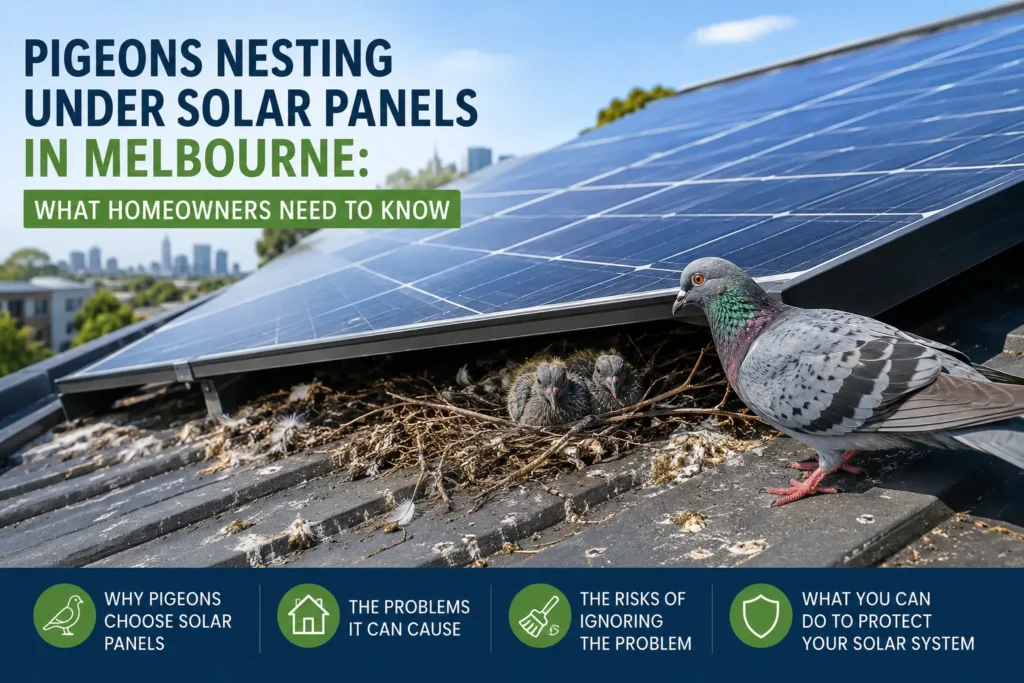
If you’ve noticed pigeons constantly sitting on your roof, hearing cooing every morning, or watching birds disappear underneath your solar panels, there’s a good chance they may be nesting beneath the system.
This is one of the most common problems we see across Melbourne. Many homeowners initially think it’s just a couple of birds hanging around, but in reality, solar panels create an ideal nesting environment for pigeons.
In this guide, we’ll explain why pigeons nest under solar panels, the warning signs to look for, what can happen if the problem is ignored, and the most effective long-term solution.
Why Do Pigeons Nest Under Solar Panels?
From our experience, pigeons are attracted to the sheltered space underneath solar panels.
The area provides:
- Protection from rain and harsh weather
- Shelter from predators
- Warmth during cooler periods
- A quiet place to build nests and raise young
Once pigeons choose a nesting location, they become surprisingly attached to it.
Many homeowners assume the birds will eventually leave on their own. While activity may temporarily decrease between breeding cycles, the pigeons often return to the exact same location later and continue nesting.
Over time, what starts as a couple of pigeons can grow into a much larger problem.
The First Signs of Pigeons Nesting Under Solar Panels
One thing we’ve noticed over the years is that most homeowners don’t discover the nest straight away.
Instead, they usually notice a series of warning signs.
Birds Constantly Sitting on the Roof
The first sign is often repeated pigeon activity.
Seeing a bird occasionally isn’t unusual. However, if the same pigeons are visiting your roof every day, it’s worth paying attention.
Morning Cooing and Scratching Sounds
Many customers contact us because they’re hearing cooing, scratching or movement on the roof early every morning.
This is one of the most common indicators that pigeons have made themselves at home underneath the solar panels.
Birds Disappearing Under the Panels
If you can actually see birds crawling or flying underneath the panels, that’s a strong indication they’re nesting there.
In our experience, pigeons generally have no reason to go underneath the panels unless they’re building nests, sheltering or raising young.
Birds Carrying Sticks
Another tell-tale sign is pigeons carrying nesting material.
If you see birds flying onto the roof with sticks, twigs or other materials and disappearing underneath the solar panels, they’re almost certainly building a nest.
Droppings and Gutter Debris
As nesting activity increases, many homeowners begin noticing:
- More bird droppings around the property
- Debris in gutters
- Nesting material appearing on the roof
Sometimes homeowners only discover the true cause when cleaning their gutters and finding large amounts of droppings and nesting material.
What Happens If You Ignore the Problem?
One of the biggest misconceptions we hear is:
“They’ll eventually leave.”
Unfortunately, that’s usually not what happens.
Pigeons may appear to disappear for a short period between breeding cycles, leading homeowners to believe the problem has solved itself.
Then they come back.
Often with more birds.
In our experience, two pigeons rarely stay two pigeons for long.
A small nesting problem can gradually become:
- Multiple nests
- Large amounts of droppings
- Ongoing noise
- Blocked gutters
- Heavy contamination around the solar system
The longer the problem remains, the larger the cleanup tends to become.
Real Example: One of the Worst Nesting Jobs We’ve Seen
One of the most severe jobs we’ve encountered started with a homeowner noticing what they described as “some pigeon activity” on the roof.
They weren’t particularly concerned but thought it might be worth checking.
What we found underneath the solar panels was far worse than expected.
The system contained approximately 10 to 15 nests underneath the panels.
There were:
- Large amounts of droppings
- Nesting debris throughout the array
- Droppings covering sections of the roof
- Gutters filled with waste and nesting material
- Dead pigeons underneath the panels
- Solar cables hanging loose and resting on the roof
- Scratches on the metal roof caused by years of pigeon activity
- A strong odour from the nesting area
The homeowners were shocked when they saw the photos.
They had expected a few birds.
Instead, they discovered an established pigeon colony that had been growing unnoticed for quite some time.
Can Pigeons Damage Solar Panels?
While pigeons aren’t usually damaging the solar panels directly, the problems they create around the system can become significant.
Solar Panel Contamination
One of the most common issues is bird droppings covering the surface of the panels.
Heavy contamination can reduce the amount of sunlight reaching the solar cells and may impact system performance.
This is one reason many homeowners combine bird proofing with solar panel cleaning.
Nesting Material Build-Up
Large amounts of dry nesting material can accumulate underneath the array over time.
In severe cases, entire sections underneath the panels can become packed with debris.
Displaced Solar Cables
We’ve regularly seen situations where solar cables that should be secured to the panel frame have become displaced over time.
Rather than remaining clipped neatly in place, some cables end up resting directly on the roof surface.
Blocked Gutters
Nesting material, sticks and droppings frequently find their way into gutters.
This can contribute to:
- Water overflow
- Blockages
- Increased maintenance requirements
Roof Wear
On metal roofs, we’ve observed scratching and surface wear caused by ongoing pigeon activity.
While every roof is different, prolonged infestations can create more problems than many homeowners realise.
Why Some Homes Get Pigeon Problems and Others Don’t
This is one of the most common questions homeowners ask.
The honest answer is that there isn’t always a clear reason.
One pattern we’ve noticed is that double-storey homes often seem to attract more pigeon activity than surrounding single-storey properties.
For example, if there’s one taller home in an area of lower houses, pigeons often appear to favour it.
That said, we’ve also seen plenty of serious infestations on single-storey homes.
The biggest factor isn’t necessarily the roof itself.
It’s whether pigeons have already established a nesting location underneath the solar panels.
Once they do, they tend to keep returning.
What’s the Best Long-Term Solution?
In our opinion, professional mesh bird proofing is by far the most effective long-term solution.
The reason is simple.
The problem isn’t that pigeons like your roof.
The problem is that they like the nesting space underneath your solar panels.
Remove the nests and prevent access underneath the panels, and you’ve addressed the root cause.
A properly installed solar panel bird proofing system creates a physical barrier around the perimeter of the array, preventing pigeons from accessing the space underneath.
When installed correctly using quality materials and proper solar clips, it provides a long-term solution.
Common DIY Bird Proofing Mistakes
Over the years we’ve seen countless DIY attempts that didn’t solve the problem.
Some examples include:
- Hanging CDs from roofs
- Plastic owls
- Rubber snakes
- Sonic deterrent devices
- Cheap plastic mesh
- Partial installations
- Leaving corners unprotected
- Gaps between panel rows
The issue with most DIY solutions is that they don’t stop access underneath the panels.
As long as pigeons can still reach the nesting area, the problem usually continues.
What Happens After Bird Proofing Is Installed?
One thing homeowners should understand is that pigeons don’t always disappear immediately.
If birds have been nesting under the panels for a long time, they may continue returning to the roof out of habit.
This doesn’t mean the bird proofing isn’t working.
It simply means they’re returning to a location they’ve become accustomed to.
Over time, once they realise they can no longer access the nesting area, they move on.
Customers commonly report:
- Quieter mornings
- No more cooing
- Fewer birds around the property
- Cleaner gutters
- Cleaner solar panels
- Relief from ongoing pigeon problems
For most homeowners, the biggest benefit is simply getting their roof back.
What Should You Do If You Notice Pigeons Around Your Solar Panels?
If you’ve recently started noticing pigeon activity, don’t panic.
But don’t ignore it either.
Keep an eye out for signs such as:
- Birds disappearing underneath the panels
- Birds carrying sticks
- Morning cooing or scratching sounds
- Daily pigeon activity
- Droppings around the roof
- Nesting material in gutters
If it’s safe to do so, you may be able to inspect the gap underneath the solar panels from ground level.
Sometimes you can see daylight passing underneath the array.
If the gap appears blocked by dark material, there may already be nesting activity underneath.
The most important thing is acting early.
In our experience, early bird proofing is almost always easier, cleaner and less expensive than dealing with a large established colony later.
Frequently Asked Questions
Is bird proofing worth doing if I only have a couple of pigeons?
Yes. In most cases, it’s much easier to deal with a small nesting problem before it becomes a large colony.
How long does solar panel bird proofing last?
A professionally installed system using quality stainless steel mesh and solar clips can provide long-term protection for many years.
Can bird proofing be added to existing solar panels?
Yes. Most residential solar systems can be bird proofed after installation without removing the panels.
What's the best bird proofing solution for solar panels?
Professional perimeter mesh systems are widely considered the most effective long-term solution because they physically prevent access underneath the panels.
Do bird spikes work on solar panels?
Bird spikes may discourage birds from landing in certain locations, but they generally don’t prevent pigeons from accessing the space underneath solar panels.
Can pigeons damage solar panels?
While pigeons don’t normally damage the panels directly, they can create issues such as heavy contamination, displaced wiring, blocked gutters and excessive nesting debris.
Will pigeons leave on their own?
Usually not. Activity may temporarily decrease between breeding cycles, but pigeons often return to the same nesting location and continue using it.
How do I know if pigeons are nesting under my solar panels?
Common signs include morning cooing, scratching sounds, birds disappearing underneath the panels, nesting material in gutters and repeated daily pigeon activity around the roof.