
If you’ve noticed pigeons nesting under your solar panels, it’s tempting to leave the problem alone and hope it goes away.
After all, if it’s only a couple of birds, how much trouble can they really cause?
This is one of the most common questions we hear from Melbourne homeowners.
Unfortunately, after seeing countless pigeon infestations over the years, we’ve found that doing nothing is usually what allows a small problem to become a much larger one.
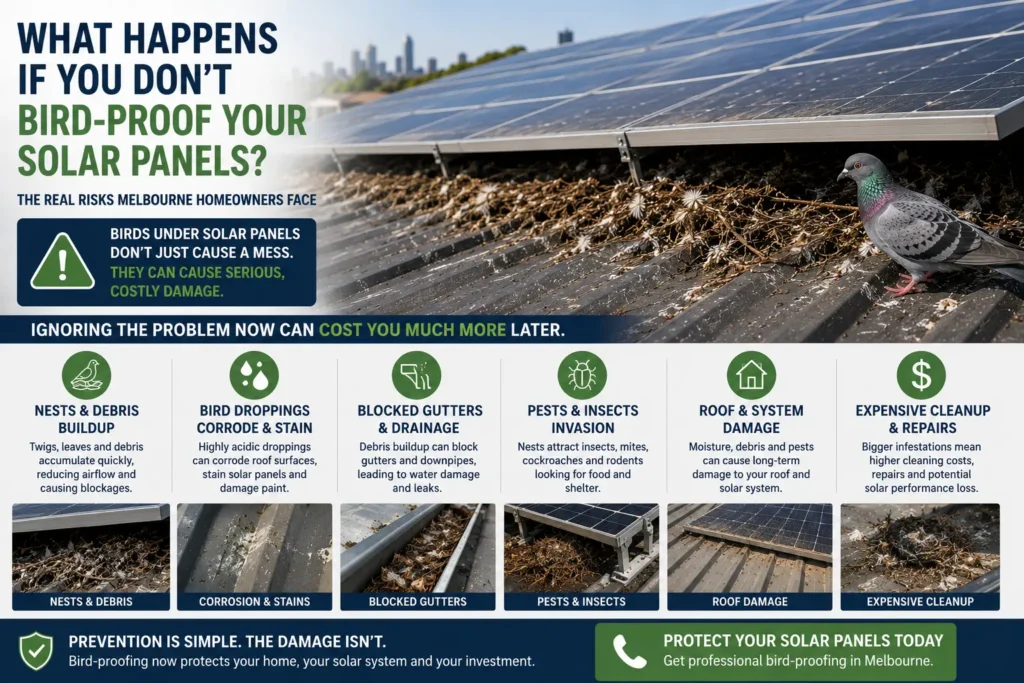
In most cases, pigeons don’t simply move on and forget about their nesting spot.
They come back.
And often they bring more birds with them.
In this guide, we’ll explain what typically happens when solar panels aren’t bird proofed, how infestations develop over time, and why many homeowners eventually say:
“I wish I had dealt with it sooner.”
The Short Answer: The Problem Usually Gets Worse
One of the biggest misconceptions homeowners have is believing pigeons will eventually leave on their own.
Sometimes they appear to.
The activity may decrease for a while, the noise stops temporarily, and everything seems normal again.
The problem is that pigeons often return to the same nesting location.
What looks like the end of the problem is often just a temporary break between nesting cycles.
In our experience, it’s very unusual for an established nesting site to simply stop being used without some form of intervention.
How a Typical Pigeon Problem Develops
Every property is different, but we’ve seen a fairly consistent pattern over the years.
The Early Stage
At first, homeowners usually notice:
- One or two pigeons on the roof
- Morning cooing
- Occasional scratching sounds
- Birds disappearing underneath the panels
At this stage, there may only be one nest.
Many homeowners don’t consider it a serious problem.
The Established Stage
Over time, more birds begin returning to the site.
The nesting activity increases.
You may start noticing:
- More birds on the roof
- More noise
- More droppings
- Nesting material appearing in gutters
- Birds visiting daily
This is often when homeowners start looking for solutions.
The Advanced Stage
If the problem continues unchecked, the colony can grow significantly.
At this point, it’s common to find:
- Multiple nests
- Large amounts of droppings
- Significant nesting debris
- Blocked gutters
- Heavy roof contamination
- Dead birds underneath the panels
The cleanup becomes larger, the labour increases and the overall cost of fixing the problem usually rises.
Sometimes the Problem Starts Bigger Than You Think
Not every infestation begins with two pigeons.
One interesting pattern we’ve noticed involves neighbouring properties.
Let’s say your neighbour has a large pigeon infestation under their solar panels.
Eventually they decide to install solar panel bird proofing.
Now those pigeons need somewhere else to go.
Because pigeons are highly location-oriented, they often don’t move far away.
Instead, they may start investigating nearby roofs.
If your solar panels are accessible, your property can suddenly become the next nesting location.
In situations like these, a homeowner can go from having no problem at all to inheriting a large colony surprisingly quickly.
The Noise Usually Gets Worse
One of the first complaints we hear from customers is noise.
At the beginning, it may just be occasional cooing.
As the colony grows, homeowners often report:
- Constant morning noise
- Scratching sounds
- Birds moving around underneath the panels
- Increased activity throughout the day
Many people initially tolerate the noise because they assume it won’t last.
However, when the same sounds continue month after month, it often becomes one of the main reasons they finally decide to act.
The Mess Builds Up Faster Than Most People Expect
If there’s one thing that consistently surprises homeowners, it’s the amount of mess pigeons create.
Most people never see underneath their solar panels.
They assume a few birds can’t be causing much trouble.
Then they see the photos.
Time and time again, homeowners are shocked by:
- The amount of droppings
- The number of nests
- The volume of nesting material
- Dead birds hidden underneath the panels
- Debris accumulating in the gutters
Many simply underestimate how much waste pigeons can generate in a relatively short period of time.
Your Gutters Can Become Blocked
As nesting material accumulates underneath the solar panels, it often finds its way into nearby gutters.
Combined with bird droppings, this can lead to:
- Gutter blockages
- Poor drainage
- Overflow during rain
- Increased maintenance requirements
We’ve seen many situations where a homeowner only discovered the extent of a pigeon infestation after investigating blocked gutters.
Solar Panels Can Become Covered in Droppings
Another common consequence of leaving an infestation untreated is contamination of the solar panels themselves.
Bird droppings can accumulate on the surface of the panels, reducing the amount of sunlight reaching the solar cells.
This may contribute to reduced solar performance and often creates the need for professional solar panel cleaning.
The longer the contamination remains, the more difficult it can become to clean.
Roof Problems Can Develop Over Time
The biggest damage we typically see isn’t the solar panels themselves.
It’s everything around them.
Long-term infestations can contribute to:
- Roof contamination
- Staining
- Surface wear
- Scratching on metal roofs
- Ongoing maintenance issues
The larger the colony becomes, the greater the amount of waste accumulating around the solar system.
Bird Lice and Other Unpleasant Surprises
Most homeowners don’t associate pigeons with pest problems.
However, we’ve seen situations where long-term infestations eventually led to bird lice issues within the home.
This obviously doesn’t happen in every case.
But it serves as another reminder that the consequences of ignoring a pigeon problem can extend well beyond the solar panels themselves.
The Real Cost of Waiting
One of the most common mistakes homeowners make is saying:
“I’ll deal with it next year.”
Or:
“I can’t afford it right now.”
While that may seem reasonable at the time, the problem is that pigeons rarely stop nesting while you wait.
We’ve seen homeowners who initially delayed bird proofing because they wanted to save money.
When they eventually called back months later, they needed:
- More extensive cleanup
- Gutter cleaning
- Solar panel cleaning
- Larger nest removal jobs
In some cases, the total cost of resolving the infestation was significantly higher than it would have been if they had acted earlier.
The Worst-Case Scenario
Most infestations don’t reach this point.
But when they do, the costs can become substantial.
One of the worst cases we’ve encountered involved a homeowner who ultimately needed:
- Solar panels removed
- The roof professionally cleaned
- Areas underneath the panels cleaned and restored
- Roof repainting
- Roof restoration work
- Gutter cleaning
- Solar system reinstallation
- Bird proofing installed afterwards
This wasn’t caused overnight.
It was the result of a problem being allowed to grow over a long period of time.
The cost of all that work was dramatically higher than the cost of installing bird proofing when the problem first appeared.
The Biggest Mistake Homeowners Make
Looking back at hundreds of bird proofing jobs, the most common mistake isn’t failing to notice the problem.
It’s underestimating it.
Homeowners often tell themselves:
- “It’s only a couple of birds.”
- “They’ll leave eventually.”
- “It’s not causing any harm.”
- “I’ll sort it out later.”
Unfortunately, those assumptions are often what allow small infestations to become large ones.
The reality is that pigeons are persistent.
Once they establish a nesting location underneath solar panels, they tend to keep returning.
Is Bird Proofing Worth Doing?
In our experience, yes.
Not because every pigeon infestation turns into a disaster, but because bird proofing addresses the problem before it has the chance to grow.
A professionally installed bird proofing system prevents access underneath the solar panels and removes the reason pigeons keep returning.
For most homeowners, that means:
- Less noise
- Fewer maintenance issues
- Cleaner gutters
- Cleaner panels
- No ongoing nesting problems
Most importantly, it prevents a small issue from turning into a much bigger one.
Frequently Asked Questions
Will pigeons eventually leave on their own?
Sometimes activity temporarily decreases between nesting cycles, but established nesting locations are often reused. In our experience, the problem rarely disappears permanently without intervention.
What happens if I ignore pigeons under my solar panels?
The colony typically grows over time, resulting in more nests, more droppings, more noise and larger cleanup requirements.
How quickly can a pigeon problem get worse?
This varies. Some infestations grow gradually over several years, while others develop quickly if a large number of pigeons move in from a nearby property.
Can leaving pigeons under solar panels become expensive?
Yes. The longer an infestation remains, the more likely it is that additional cleaning, maintenance and repair work will eventually be required.
Can pigeons block gutters?
Yes. Nesting material and droppings commonly end up in gutters and can contribute to blockages.
Will bird proofing stop pigeons from returning?
A properly installed bird proofing system prevents access underneath the solar panels, which removes the main reason pigeons keep returning to the roof.
What are the first signs I should watch for?
Common signs include birds disappearing underneath the panels, morning cooing, scratching sounds, droppings around the roof and nesting material appearing in gutters.
Is it better to bird proof early?
Absolutely. In most cases, addressing the problem early is simpler, cleaner and less expensive than dealing with a large established colony later.