
The part that actually stops pigeons is not the label on the product. It is the physical barrier around the full perimeter of the solar panels. If pigeons cannot squeeze under the frame, they cannot use the panels as a nesting shelter.
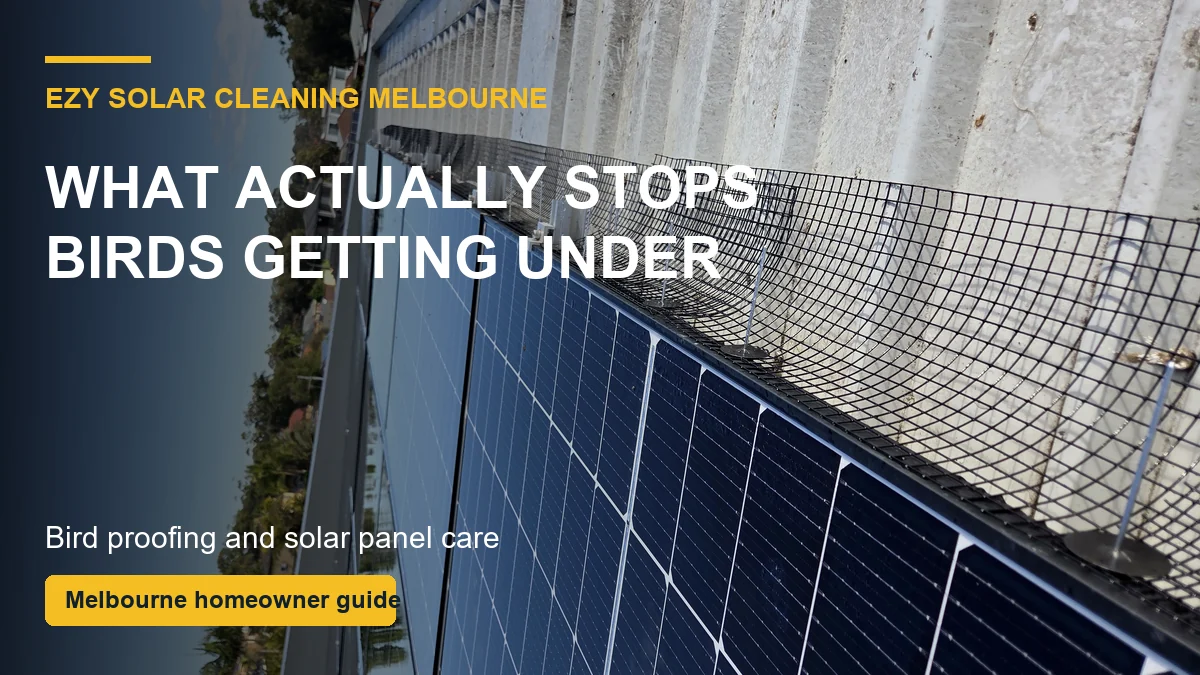
Good pigeon proofing for solar panels comes down to three things: strong mesh, the right clips, and careful workmanship with no gaps left behind.
Full perimeter coverage matters most
Solar panels sit above the roof with a gap underneath. Pigeons only need one usable entry point. If the front looks sealed but a corner, side edge or awkward roof section is left open, birds may still find their way in.
That is why a proper job is not just a strip of mesh along the easiest edge. It should follow the whole exposed perimeter and be shaped neatly around mounting points and obstacles.
The mesh needs to be suitable for rooftops
EZY Solar Cleaning Melbourne uses black PVC-coated stainless steel mesh because it is durable, weather resistant and neat beside dark panel frames. Plastic mesh, plastic gutter guard and light netting can lose shape, crack or become ineffective over time.
The mesh should be firm enough to hold its shape but flexible enough to follow the panel edge. It should block access without looking messy from the ground.
Melbourne roofs deal with sun, wind, rain and temperature changes through the year. A material that looks fine on installation day still needs to keep doing its job years later. That is why thin plastic, light netting or improvised gutter guard can be a poor long-term choice around solar panels.
Clips matter as much as mesh
A strong mesh can still fail if it is attached poorly. The clips need to suit the solar panel frame and hold the barrier in position through wind, heat and normal roof conditions. Different panel systems can require different clip choices, which is why public advice should stay practical rather than pretending every roof is the same.
The key public-facing point is simple: professional solar-specific clips are preferred, and the installation should avoid drilling into the panels or roof.
What causes pigeon proofing to fail?
| Failure point | What can happen |
|---|---|
| Gaps at corners | Birds test the edge and find a way back underneath |
| Weak plastic mesh | The material bends, cracks or loses shape |
| Poor clips | Mesh shifts away from the panel frame |
| Incomplete perimeter | The easy side looks finished but another side stays open |
| Rushed clean-out | Old nesting material keeps attracting birds back |
These are workmanship and product-quality issues, not proof that mesh itself does not work. For more examples, the article on common bird proofing mistakes covers what homeowners should avoid before booking.
Why cheap-looking shortcuts are easy to miss
From the ground, a cheap job can look acceptable for a short time. The problem is usually in the details: a loose corner, a clip spacing issue, mesh pushed too far away from the frame, or a rear edge that was never sealed properly. The homeowner may not notice until birds start returning.
That is why photos matter. Before and after photos help show whether the panel edges have been followed properly and whether awkward corners were handled neatly. They also give the homeowner a record of the work completed on the roof.
Why drilling, glue and welding should be avoided
Most homeowners are rightly cautious about anything attached to a solar system. A professional mesh installation should use solar-specific clips and avoid drilling, gluing or welding. Warranty questions can depend on the solar manufacturer, but careful attachment methods are generally the safer approach.
What about birds sitting on top of the roof?
Pigeon proofing does not make the entire roof invisible to birds. They may still land nearby, especially soon after the job. What matters is whether they can get underneath the panels. If they cannot access the old nesting area, they lose the main reason to keep returning.
How to judge a good result
A good result should look neat, follow the panel lines, have no obvious gaps and use materials designed for long-term rooftop exposure. The roof should look cleaner and calmer, not covered in random deterrents.
If the installer can explain the material, attachment method and perimeter coverage in plain language, that is usually a good sign. If the explanation is only that the job is cheap, the homeowner has not learned much about whether the birds will actually be blocked.
If you are comparing options, it is worth looking beyond the lowest number and reading about bird proofing cost in Melbourne. The cheapest job can become expensive if it has to be repaired or replaced later.
FAQs
What actually stops pigeons getting under solar panels?
A full perimeter mesh barrier installed with suitable solar clips is the key. It physically blocks the gap pigeons use.
Is plastic mesh good enough?
Plastic mesh can deteriorate, crack or lose shape. PVC-coated stainless steel mesh is generally a stronger long-term option.
Does pigeon proofing need drilling?
A professional solar mesh installation should avoid drilling into the panels or roof and use solar-specific clips instead.
Can one small gap cause a problem?
Yes. Pigeons only need one access point, so corners and difficult edges matter.
Is the finished mesh visible?
It can be visible up close, but black mesh usually blends neatly with the solar panel frame when installed well.