
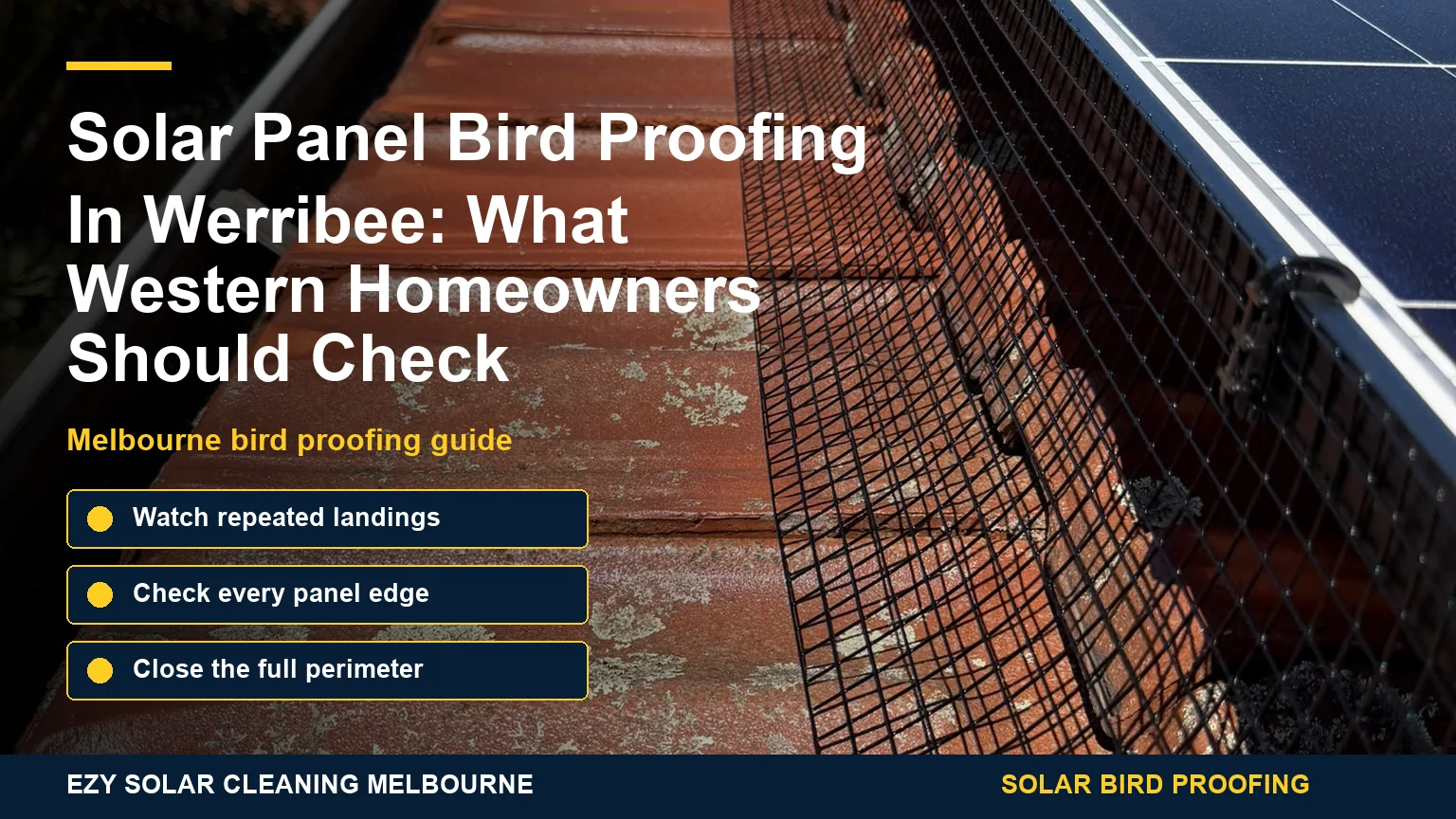
Pigeons do not need a damaged solar system to move in. They only need an accessible gap that gives them shade, shelter and a place to build a nest. For Werribee and western Melbourne homeowners, the most useful question is therefore not simply whether birds are on the roof. It is whether they are repeatedly inspecting or entering the space underneath the panels.
Bird proofing is most straightforward before that space contains months of nesting material and droppings. The checks below help you tell the difference between occasional bird activity and an access problem that is becoming established.
Start with the birds’ routine
A pigeon resting on a ridge once is not proof of a nest. A repeated routine is more meaningful. Watch from the ground at different times of day and look for birds that land at the same panel edge, walk along the frame, disappear underneath or return carrying twigs.
Early-morning cooing or scratching can be another clue because the roof is quiet and birds are leaving their shelter. Droppings concentrated below one side of the array, feathers near a downpipe or sticks collecting in one gutter section may point to the same area.
| What you can see safely | What it may indicate |
|---|---|
| Birds repeatedly entering one panel edge | An accessible route under the array |
| Twigs or feathers below the panels | Nesting material is being carried in or pushed out |
| Droppings concentrated in one place | A regular landing, roosting or nesting point |
| Noise soon after sunrise | Birds may be settled beneath the panels |
| One gutter blocking faster than the rest | Debris may be collecting above it |
These signs do not require you to climb onto the roof. Ground-level photos and a description of the pattern are safer and more useful than trying to inspect underneath the panels yourself.
Why western Melbourne roofs can develop a problem suddenly
A solar array can remain quiet for years before pigeons begin using it. Local bird numbers change, nearby nesting sites are removed, and birds may shift when another property is proofed. New development can also change the sheltered ledges and roof spaces available in an area.
Once pigeons find a protected location, a temporary quiet period does not necessarily mean they have abandoned it. They can return to a familiar shelter after weather changes or disturbance. This is why watching the pattern over several days is more reliable than making a decision after one quiet afternoon.
The Werribee location pageprovides the local service context, while the Melbourne solar panel bird proofing service explains the broader installation approach.
Check the whole solar layout, not just the busiest corner
Homes may have panels split across several roof faces, a second row set at a different height, or another array on a garage. Pigeons often make their activity obvious at one corner, but that does not prove it is the only opening.
A durable job considers the full accessible perimeter. Corners, changes in panel height, cable routes and narrow gaps between sections deserve close attention. If one usable opening remains, birds may keep testing it after the obvious side is closed.
Ask whether every array shown in the quote is included. A low price can sometimes describe one section while leaving a garage or rear-roof array outside the scope.
What proper solar bird mesh should achieve
The purpose of mesh is physical exclusion. It closes the gap between the panel frame and the roof while allowing the panels to stay in place. EZY Solar Cleaning Melbourne uses coated stainless steel mesh fitted with solar-specific clips. The installation should not rely on glue or welding, and it should not require drilling into the panels or roof.
Good workmanship matters as much as the material. The mesh needs to follow the roof profile, sit neatly against the panel edge and remain closed around corners and obstacles. A visually tidy installation is usually also a sign that the mesh has been shaped deliberately rather than pushed roughly into place.
Pigeons may continue sitting on the roof for a while after installation. Success means they cannot get underneath, not that every bird immediately leaves the neighbourhood.
Work out whether cleaning belongs in the scope
Bird proofing and cleaning solve different parts of the problem. Mesh prevents access. Cleaning removes contamination already on the panel glass. A clean-out removes nests and loose debris from beneath the array where required.
If birds have only just started testing a clean roof, proofing may be the main task. If they have nested for months, the job may also involve removing material and addressing droppings before the perimeter is closed. Solar panel cleaning in Melbourne can be included when the glass has visible bird mess or general build-up, but it should not be confused with excluding the birds.
Questions worth asking before accepting a quote
Ask the contractor to explain the scope in plain language:
- Is the full perimeter of every included array being closed?
- What type of mesh and clips will be used?
- Will the installation involve drilling, glue or welding?
- Are nests and loose debris removed where required?
- Is panel cleaning included or separately priced?
- How will difficult corners and roof-profile gaps be finished?
- Will you receive completion photographs?
- What material and workmanship warranty applies?
The quote should also make clear what happens if roof access reveals broken tiles or another issue outside the bird-proofing work. Clear boundaries protect both the homeowner and contractor.
When early proofing makes sense
You do not need to wait until a nest is falling into the gutter. Early proofing is sensible when pigeons repeatedly inspect the panel edge, neighbouring roofs have established activity, or a previous nesting site has made your roof an obvious alternative.
If birds are merely passing overhead, monitoring may be enough. The decision becomes stronger when their behaviour is repetitive and focused on the underside of the array.
The practical Werribee takeaway
Judge the situation by access and repetition. Birds that keep returning to the same panel edge are telling you more than birds that simply cross the roof. Check every array, confirm exactly what a quote includes and choose a method that closes the full perimeter without drilling into the roof or panels.
FAQ
How can I tell if pigeons are under my solar panels?
Repeated entry at one edge, early-morning noise, concentrated droppings, feathers and nesting material are common clues. Observe from the ground rather than climbing onto the roof.
Can bird mesh be fitted before pigeons build a nest?
Yes. Preventive installation is often simpler because there may be less debris and contamination to remove first.
Does every side of the solar array need mesh?
Every accessible part of the perimeter should be assessed. Closing only the most visible side can leave another route underneath.
Will the mesh damage tiled or metal roofing?
A suitable installation uses solar-specific clips at the panel edge and avoids drilling into the roof. Existing roof condition and access still need to be considered.
Is solar panel cleaning automatically included?
Not necessarily. Bird proofing, nest removal and panel cleaning are separate tasks, so the quote should identify what is included.
Do you service areas around Werribee?
EZY Solar Cleaning Melbourne services Werribee and surrounding western Melbourne areas, subject to access and job requirements.