
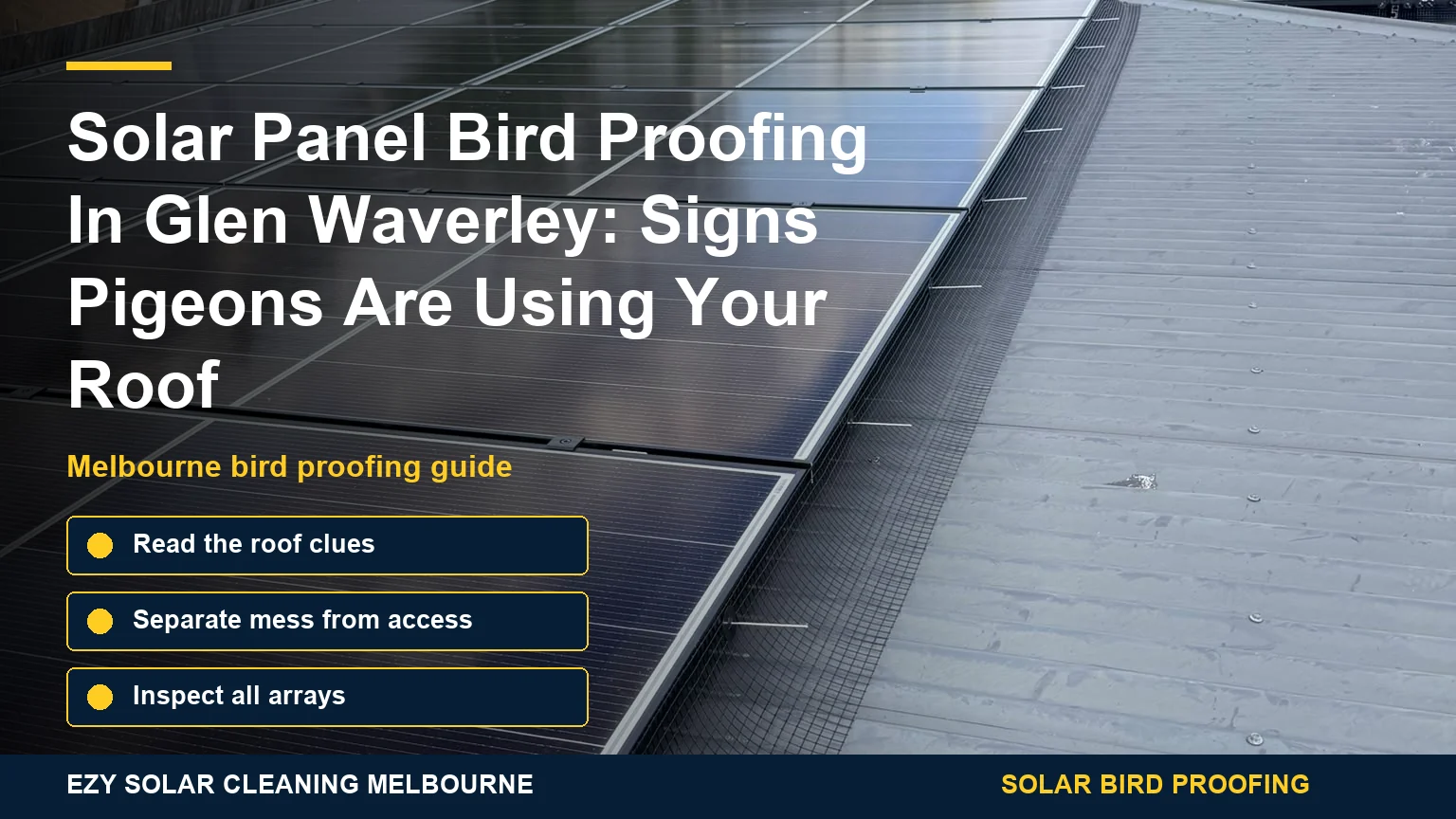
The clearest sign of a solar-panel pigeon problem is not the number of birds in the street. It is repeated behaviour around your own array. When pigeons land at the same edge, disappear beneath the panels and return day after day, they are using the roof as more than a resting place.
For Glen Waverley homeowners, recognising that pattern early can mean the difference between a straightforward exclusion job and a larger clean-out involving nests, droppings and blocked gutters.
A roof can look quiet from the driveway
Solar panels hide much of the area beneath them. A homeowner may see two pigeons and assume the issue is small while nesting material is collecting out of sight. Conversely, several birds sitting on a powerline do not prove they live under the panels.
Look for connected clues rather than relying on one sighting. Birds entering at one corner, cooing before sunrise, droppings below the same eave and twigs appearing in the gutter form a much stronger picture together.
Repeated entry at the panel edge
Watch whether a bird lands, walks toward the frame and vanishes. If the behaviour happens repeatedly, the gap is likely serving as shelter. Birds may use different sides depending on wind, shade and how the roof is approached, so observe more than one face where that is safely possible.
Noise that follows a daily rhythm
Cooing, fluttering and scratching are often easiest to hear early in the morning. Intermittent noise alone can have several causes, but a regular sound that aligns with pigeons arriving or leaving deserves attention.
Mess concentrated below one section
Droppings on paving, a deck or one stretch of gutter can reveal the favourite landing point above. Feathers, eggshell fragments or sticks make active nesting more likely. Do not handle contaminated material unnecessarily or climb up to investigate it.
What each sign can and cannot tell you
| Observation | Useful conclusion | What it does not prove |
|---|---|---|
| Pigeons sit on the roof ridge | Birds are comfortable around the property | That they are nesting under panels |
| A bird repeatedly disappears below the frame | There is probably an accessible gap | How much mess is already underneath |
| Droppings cover part of the panel glass | Cleaning may be useful | That cleaning will stop the birds returning |
| Twigs collect in a gutter below the array | Nest material may be moving from above | The complete condition under every panel |
| Noise stopped for several days | Activity may have reduced temporarily | That the nesting site has been abandoned |
This distinction keeps the advice proportionate. Bird proofing should respond to a real access risk, while cleaning should respond to contamination. They often occur together, but they are not the same service.
Why cleaning alone does not close the nesting site
Washing droppings from the glass can improve appearance and remove contamination, but the sheltered gap remains available. If pigeons still have access, new mess can return soon after the panels are cleaned.
The reverse is also worth understanding. Mesh may stop future entry, but it does not wash the panel surface. Where droppings or grime are present, solar panel cleaning may be a sensible addition after nests and loose material are dealt with.
The existing guide on cleaning before bird proofing explains how to separate these decisions.
What a complete proofing assessment covers
A useful assessment looks beyond the corner where the birds were first seen. It should consider every accessible panel edge, separate roof arrays, changes in panel height, wiring routes and obstacles that affect the mesh shape.
The Glen Waverley service area pageestablishes the local coverage. For the installation itself, professional solar panel bird proofing should use suitable coated stainless steel mesh and solar-specific clips, with no drilling into the roof or panels.
The objective is a neat physical barrier around the full perimeter. Glue, loose netting and isolated spikes do not provide the same closure. Corners must be shaped carefully because one weak opening may be enough for a determined pigeon.
What happens when birds are already established
If there is active nesting, the job may require preparation before mesh is installed. Loose nesting material and debris should not simply be sealed beneath the array. The contractor should explain what can be removed, what cleaning is included and whether any condition on the roof needs separate attention.
Bird activity can continue around the property after proofing. Pigeons familiar with the roof may return and inspect it. The result to judge is whether they can get underneath. The article Will Pigeons Still Come Back After Bird Proofing? explains this adjustment period in more detail.
Safe information to collect for a quote
You can help the assessment without climbing onto the roof. Send:
- your Glen Waverley or nearby suburb location;
- wide photos showing the roof and all solar arrays;
- the approximate panel count;
- the panel edge where birds enter;
- how long the activity has been happening;
- photos of visible droppings or gutter debris from ground level; and
- whether panels are also installed on a garage or extension.
Mention roof height, difficult side access or a steep block if known. These details affect access planning even when the solar array itself looks simple.
Choosing a response that matches the evidence
Monitoring is reasonable when birds only pass through occasionally and show no interest in the panel gap. Arrange an assessment when the behaviour is repeated, the birds are entering underneath, or the physical signs are accumulating.
Avoid waiting for an electrical fault or severe blockage before acting. Those outcomes are not inevitable, and scare tactics are not useful. The practical reason to intervene is simpler: established nesting creates more mess and usually makes the eventual work more involved.
FAQ
Are pigeons sitting on my solar panels enough reason to install mesh?
Not by themselves. Repeated attempts to enter underneath, nesting material, noise and concentrated droppings provide stronger evidence of an access problem.
Why do pigeons choose solar panels?
The gap beneath an array can provide shade and protection from weather and predators. It is the sheltered structure, not the electricity, that attracts them.
Can I check under the panels myself?
Roof access around solar equipment is hazardous. Observe from safe ground-level positions and use photographs for a professional assessment.
Will spikes stop pigeons nesting underneath?
Spikes may discourage landing on a specific ledge, but they do not close the perimeter beneath an array. Mesh addresses the actual access route.
Can bird proofing be fitted to an existing system?
Yes. Most solar bird-proofing work is performed on existing arrays without removing the panels.
Do pigeons leave immediately after proofing?
They may revisit the roof while adjusting, but properly closed mesh should prevent them from getting back underneath.