
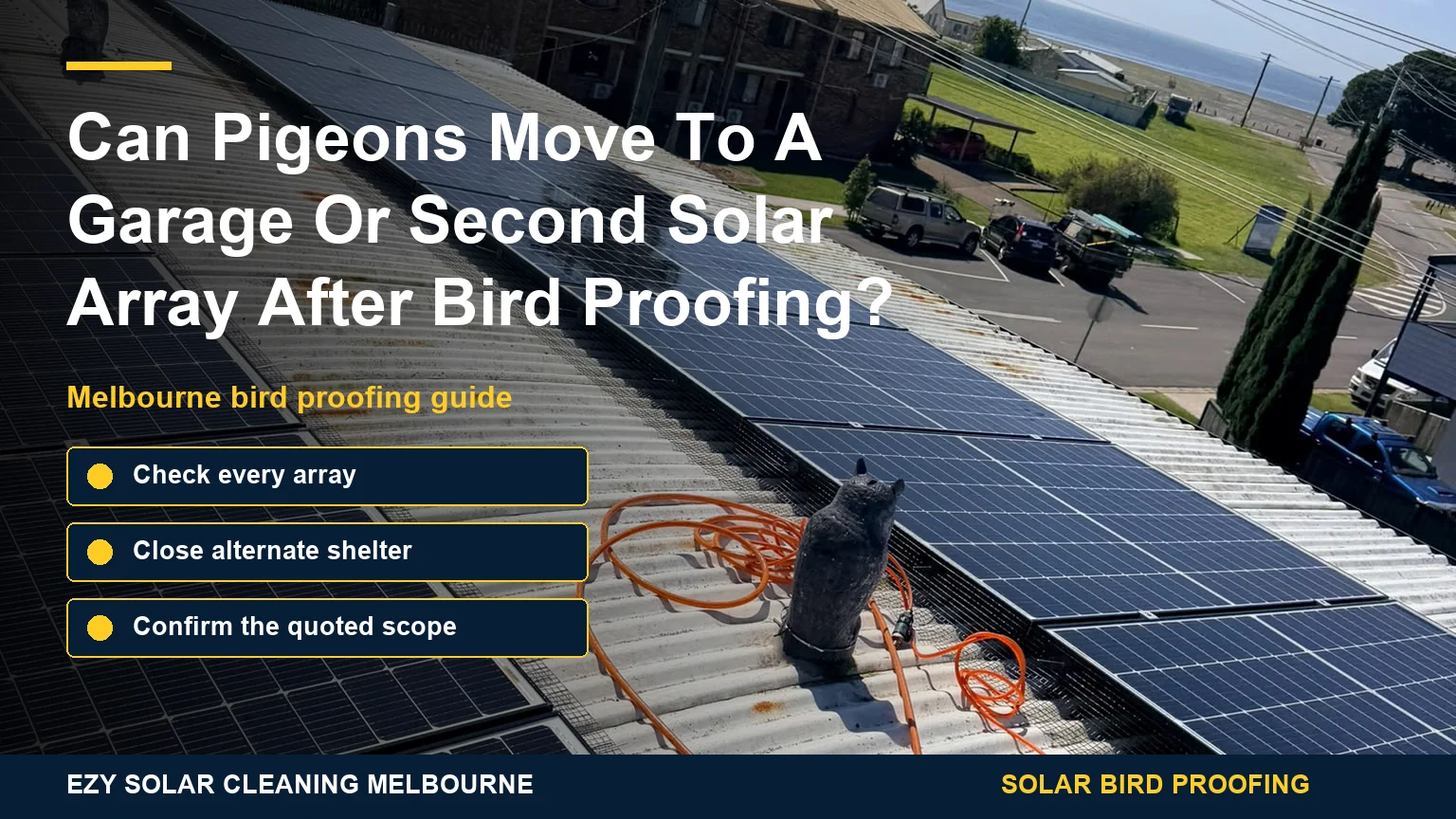
Yes. If pigeons lose access beneath one solar array, they may inspect another accessible array on the same property. A detached garage, extension, rear roof or second row of panels can offer similar shelter, especially when the birds already know the site.
This does not mean bird proofing failed. It means the original barrier worked at the section it covered while another suitable opening remained. The best way to avoid simply shifting the activity is to assess the complete solar layout before choosing the scope.
Why pigeons test nearby alternatives
Pigeons are habit-driven. Birds that have nested at a property know the surrounding rooflines, landing points and food sources. When their usual entrance is closed, they may return several times and explore nearby edges.
The closest alternative can be another part of the same home. A garage array may be lower and easier to approach. Panels on an extension can provide the same shade and weather protection as the original roof. Even a separate row only a few metres away can become attractive if its perimeter remains open.
This behaviour is different from pigeons getting through correctly installed mesh. Completion photographs and observations of the new entry point help distinguish relocation from a weakness in the original work.
Map every array before requesting a quote
Walk around the property from ground level and count each separate group of panels. Do not climb onto the roof. A useful map may include:
- the main house array;
- panels on a garage or carport;
- a smaller array on an extension;
- rows split across east- and west-facing roof sections;
- panels mounted at different heights; and
- solar hot-water equipment that may look similar from a distance.
Wide photographs are often more useful than one close-up because they show how the sections relate to each other.
Does every array need to be proofed?
Not automatically. The decision depends on access, bird behaviour and the homeowner’s risk tolerance. A second array with almost no usable gap may be less attractive than a high, sheltered opening. An array that pigeons already inspect deserves more attention.
| Situation | Practical response |
|---|---|
| Birds are entering beneath two arrays | Scope both accessible nesting areas |
| Only the main array shows activity | Assess the second array before excluding it |
| Garage panels have a similar open gap nearby | Discuss preventive proofing at the same visit |
| Second array has no visible access and no activity | Monitoring may be reasonable |
| Quote only names one roof section | Confirm explicitly what is and is not included |
The important point is informed scope. A contractor should not claim every panel group always needs mesh, but neither should a second array be ignored simply because the current nest is elsewhere.
How partial perimeter work causes confusion
Relocation can also occur within the same array when only one side is closed. Pigeons may move from the front edge to the rear, enter at a corner or use a height change between panel rows. This is why solar panel bird proofing is normally planned around the full accessible perimeter of each included array.
A quote that says “bird proof front edge” is different from one that includes full perimeter closure. Homeowners should ask for a diagram, photographs or plain-language description when the scope is not obvious.
What to expect immediately after proofing
Birds familiar with the roof may continue landing nearby for days or longer. They can walk along the mesh, inspect corners and sit on ridges. Their presence does not by itself show a defect.
Watch where they go. If they remain outside and cannot disappear beneath the protected panels, the barrier is doing its job. If they begin entering beneath garage panels or another row, record that new route from the ground and contact the installer about the unprotected section.
The article Will Pigeons Still Come Back After Bird Proofing? explains why roof visits can continue even when access has been successfully removed.
Can neighbouring homes affect the pattern?
Yes. Pigeons displaced from another roof may test yours, just as birds excluded from your property may inspect nearby structures. Bird proofing is property-specific exclusion; it does not remove pigeons from the suburb.
That is why preventive proofing can make sense when local activity is obvious and your panels offer a similar open shelter. It is also why scare devices alone are unreliable: they try to redirect birds without removing the physical opportunity.
Cleaning the old nesting area
When pigeons relocate, the original array may still contain nests, feathers and droppings. Those materials should be addressed according to the quoted scope before access is closed. The panel glass may also need solar panel cleaning if contamination is visible.
Cleaning is not a substitute for closing the second array. If birds establish themselves there, the same cycle of mess can begin again.
How to compare quote options
Ask for separate pricing or clearly identified inclusions when the property has several arrays. This lets you compare:
1. proofing only the active nesting array; 2. proofing all accessible arrays during one visit; and 3. adding clean-out or panel washing where required.
The cheapest figure may cover less roof area, so compare scope before comparing totals. Also confirm access equipment, mesh material, clip method, debris removal, photographs and warranty terms.
What if pigeons appear under a second array later?
Do not assume the first installation must be removed. The protected array can stay closed while the newly active section is assessed. Send photos showing the birds’ new entry route and check the earlier paperwork to confirm whether that section was included.
If pigeons appear to enter through the mesh on an included perimeter, contact the installer promptly with video or photographs. That is a different issue from movement to an array that was never proofed.
The practical takeaway
Bird proofing should be planned at property level, even when the work is ultimately limited to one array. Identify every group of panels, assess the openings and record which sections the quote covers. Doing that upfront reduces the chance of solving the main-roof problem only to discover the birds have adopted the garage.
FAQ
Will pigeons automatically move to my garage after bird proofing?
No, but they may inspect it if the garage has accessible panels and provides similar shelter.
Should garage solar panels always be proofed with the main roof?
Not always. Their gap, location and existing activity should be assessed so you can make an informed choice.
What if birds keep sitting on the proofed array?
They may continue visiting while adjusting. The key question is whether they can still get underneath.
Can only one side of an array be proofed?
Partial work can leave another entry route. Full accessible perimeter closure is usually the more reliable approach for an included array.
Is a second array included in a normal quote?
Only if the scope says so. Ask the contractor to list each roof section or array clearly.
How can I show the installer all my panels safely?
Take wide ground-level photographs from several sides of the property. Do not climb onto the roof for close-ups.
Does mesh prevent pigeons landing anywhere on the property?
No. It prevents access beneath the protected solar panels. Birds can still land on other roof surfaces.