
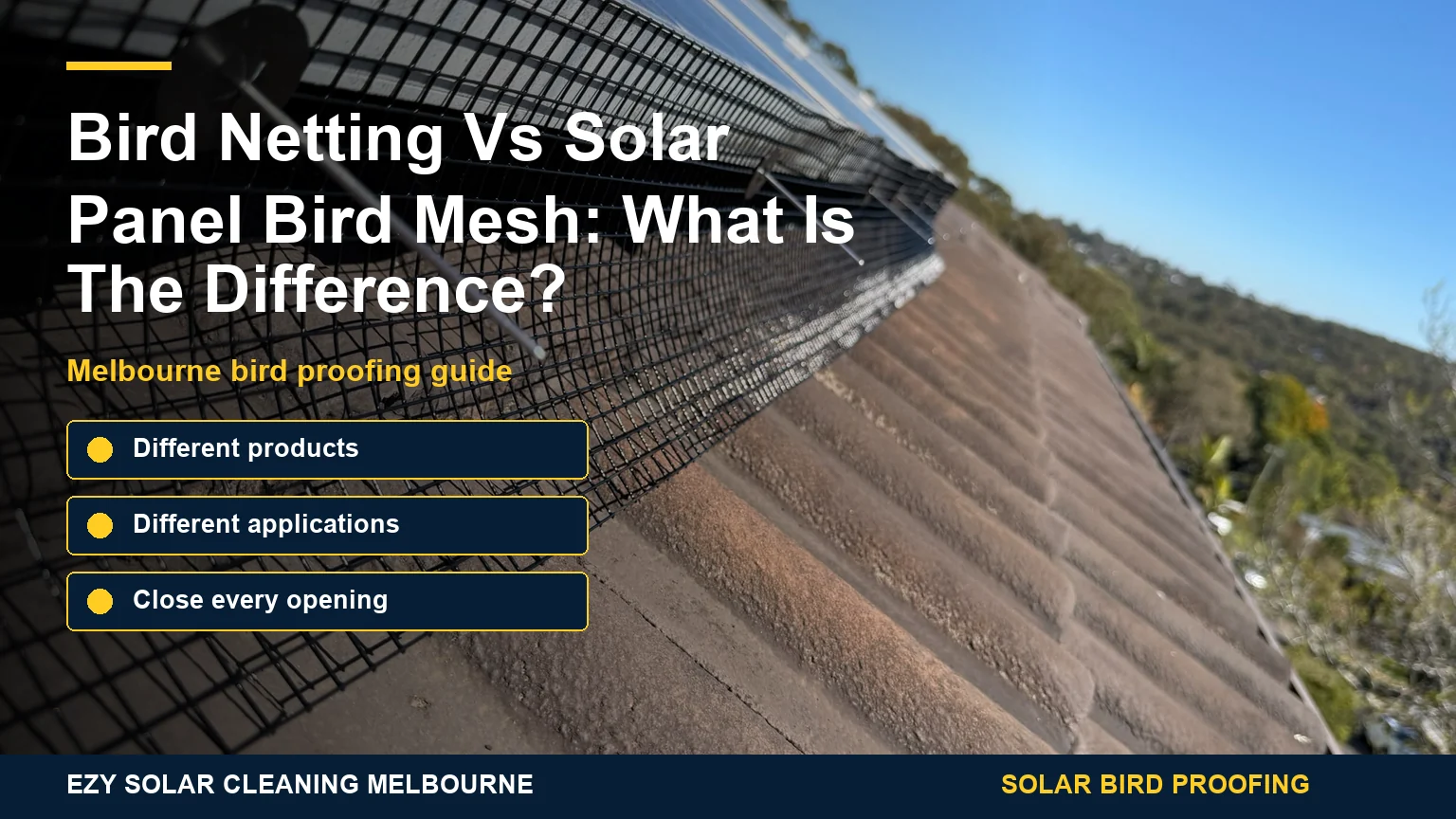
Bird netting and solar panel bird mesh are both physical exclusion products, but they are designed for different structures. Netting is usually tensioned across a large open space such as a loading area, courtyard or building recess. Solar bird mesh is a more rigid barrier shaped around the narrow perimeter between a panel frame and the roof.
For a residential solar array, the key requirement is not covering the roof with a net. It is closing the access gap neatly without drilling into the panels or roof.
Why the terminology becomes confusing
Homeowners often use “netting”, “mesh” and “wire” to describe any black grid placed near solar panels. Online product listings add to the confusion by applying broad bird-control terms to materials with very different strength, shape and installation methods.
The name is less important than the product’s behaviour on a roof. A suitable solar barrier needs enough structure to hold its shape, follow panel edges and resist leaving folds or openings. Loose netting designed to span a space is not automatically suitable just because its holes appear small.
A practical side-by-side comparison
| Feature | Bird netting | Solar panel bird mesh |
|---|---|---|
| Typical use | Enclosing larger open areas | Closing the gap around a solar array |
| Structure | Flexible and tensioned | Rigid or semi-rigid grid shaped to the perimeter |
| Attachment | Anchors and perimeter cable vary by site | Solar-specific clips attach at the panel frame |
| Roof coverage | May span a broad area | Stays close to the panel edge |
| Main challenge | Correct tension and complete enclosure | Neat corners, roof profiles and full perimeter closure |
Neither product is universally better. The correct choice depends on the structure being protected. The mistake is using a product meant for one application as a shortcut for another.
What solar panel mesh needs to do
Solar panels sit above the roof on a mounting system. That creates a long, irregular opening around the array. The roof profile may rise and fall beneath the panel edge, especially on tiled or ribbed metal roofing.
Mesh must bridge that changing gap while remaining attached to the panel frame. Solar-specific clips allow the barrier to be secured without drilling into the panel or roof. The mesh is cut and shaped around corners, rail ends and obstacles so pigeons cannot push through or find an unfinished route.
Professional solar panel bird proofing in Melbourne uses this physical-exclusion principle. The goal is not to frighten birds; it is to remove access to the sheltered space.
Why ordinary netting can be awkward around panels
Flexible netting can sag, bunch or pull away when it is not held under the type of tension it was designed for. On a solar array, that can look untidy and make it harder to maintain a consistent seal along roof contours.
Attachment is another concern. A makeshift installation may rely on adhesive, cable ties, improvised wire or roof penetrations. Those methods can age poorly, complicate servicing or create avoidable risk around the solar equipment.
This does not mean bird netting is a bad product. Proper netting is useful in the right setting. It means a panel perimeter needs a product and fastening method intended for that geometry.
Material quality still matters within solar mesh
Calling a product “solar mesh” does not guarantee quality. Plastic grids can become brittle or lose shape under rooftop UV and heat. Uncoated or unsuitable wire may corrode, mark roof surfaces or look rough. Mesh that is too light can be easier to deform.
EZY Solar Cleaning Melbourne uses premium stainless steel mesh with a UV-stabilised protective coating and solar-specific clips. Public descriptions avoid overpromising an exact lifespan because exposure, roof conditions and workmanship all matter, but the material is chosen for long-term rooftop use.
The existing article on the best bird-proofing material covers the material question in greater depth. This article focuses on why product form and application are different.
Mesh, spikes and repellents solve different problems
Spikes discourage birds from standing on a narrow ledge. Visual or sound repellents attempt to change behaviour. Netting encloses a broad space. Solar mesh closes a specific gap.
These products should not be treated as interchangeable. A spike on top of a panel does not stop a pigeon entering from the side. A fake predator may be ignored once birds learn it does not move. A loose barrier across one edge may simply redirect the entry route.
The guide Bird Repellent, Spikes Or Mesh: What Actually Works For Solar Panels? compares those behavioural and physical approaches.
Workmanship decides whether the barrier is complete
Even good mesh can fail when installation leaves a corner, cable opening or second array accessible. Look for a quote that identifies every solar array, includes the full perimeter and explains how roof-profile gaps will be handled.
Neatness is not merely cosmetic. Straight edges, carefully finished joins and close-fitting corners reduce the chance of a weak point. Completion photos are useful because much of the work may not be visible from the ground.
Questions to ask when a quote says “bird netting”
The wording may be casual, so ask for specifics before assuming the wrong product is proposed:
- Is the product flexible netting or rigid coated mesh?
- Is it intended specifically for solar-panel perimeter work?
- How is it attached to the panel frame?
- Will any drilling, glue or welding be used?
- What happens around corners and roof-profile gaps?
- Does the scope include every array?
- Are nests and loose debris removed where needed?
- Will photographs be supplied after completion?
Clear answers matter more than the label on the quote.
The short answer
Bird netting is generally a tensioned enclosure for larger open areas. Solar panel bird mesh is shaped around the relatively narrow gap beneath an array. For pigeon proofing residential panels, coated rigid mesh with solar-specific clips is usually the purpose-matched approach, provided the entire accessible perimeter is closed neatly.
FAQ
Is bird netting the same as bird mesh?
Not always. The terms are used loosely, but netting is commonly flexible and tensioned while solar mesh is a structured grid fitted around the panel perimeter.
Can ordinary plastic netting be used around solar panels?
It may not hold its shape or tolerate rooftop exposure as well as a purpose-suited coated metal mesh. Attachment and complete closure are also concerns.
How is solar bird mesh attached?
Solar-specific clips secure the mesh at the panel frame. A suitable installation avoids drilling into the roof or panels.
Does mesh stop birds landing on top of panels?
Its main purpose is stopping access underneath. Birds may still land on the roof or panel surface.
Is chicken wire suitable for solar panels?
Chicken wire is not the preferred material. It can corrode, deform and create a rougher result than coated stainless steel solar mesh.
Why must the full perimeter be covered?
Pigeons only need one usable opening. Partial coverage can redirect them to an unfinished edge rather than solve the problem.