
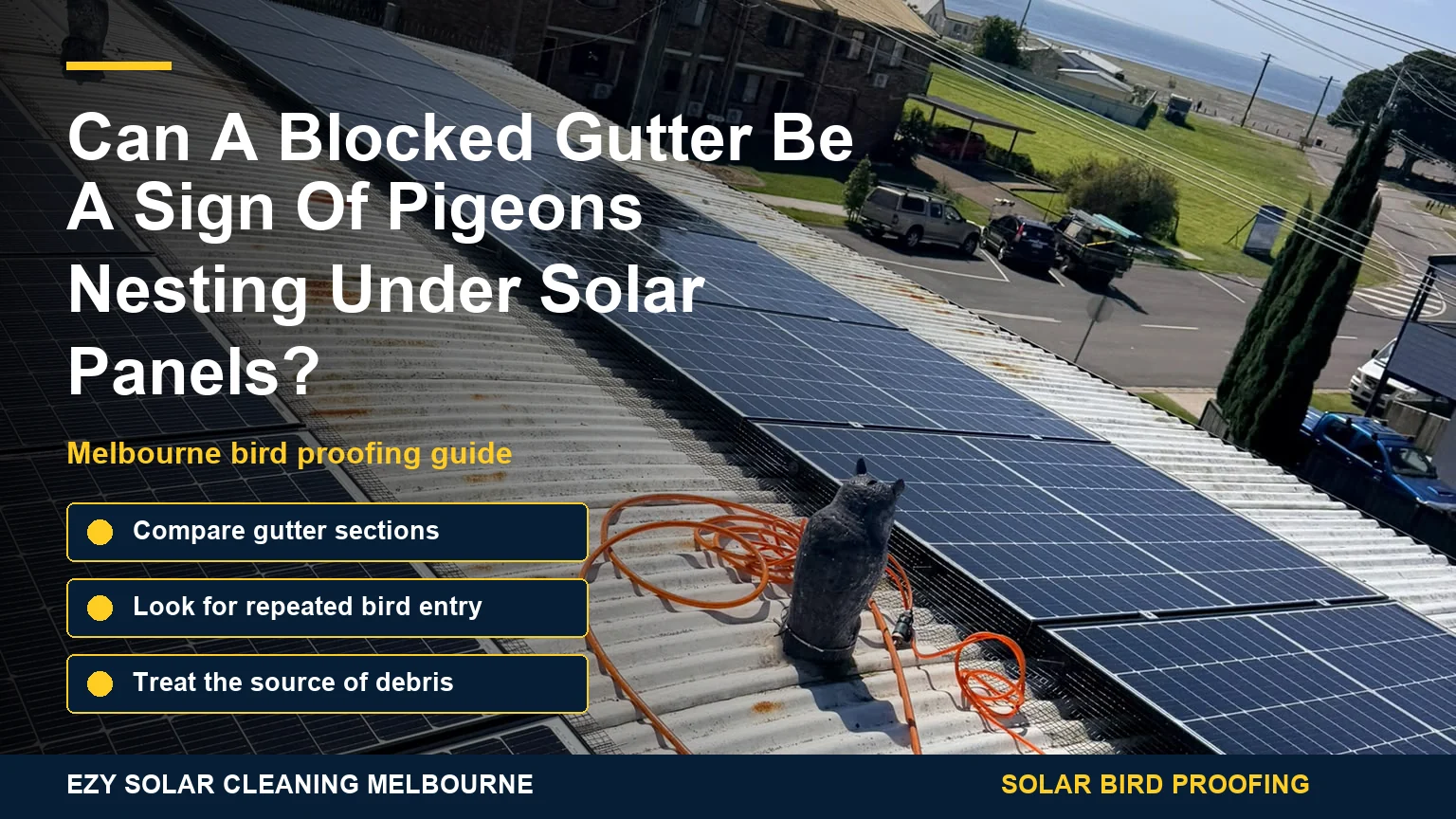
Yes. A gutter that repeatedly blocks below one solar array can be a sign of pigeons nesting under the panels, especially when sticks, feathers and droppings appear alongside regular bird activity. It is not the only possible cause, but the pattern is worth investigating.
Leaves can block any Melbourne gutter. Bird-related debris is more likely when the affected section sits directly below the panel edge and pigeons are regularly seen disappearing underneath.
Why nesting material reaches the gutter
Pigeons carry sticks and other material beneath the panels. Loose pieces move downhill with wind, vibration and rain. Droppings, feathers and abandoned nesting material can also wash toward the gutter.
Because the panels hide much of the roof, the gutter may reveal the problem before the nest itself is visible. Homeowners sometimes clean the same section repeatedly without realising more material is arriving from above.
Signs that point to birds rather than ordinary leaves
Look for a combination of clues:
- one gutter section blocking faster than the others
- twigs appearing when nearby trees are not shedding heavily
- feathers, eggshells or droppings around the downpipe
- pigeons landing near the same panel edge
- birds carrying sticks onto the roof
- cooing or scratching early in the morning
- plants growing from long-standing gutter material
- overflow directly below an active solar array
No single clue proves there is a nest. Repeated bird entry beneath the panels is the strongest visible sign.
| Observation | Possible explanation |
|---|---|
| Leaves spread across every gutter | General seasonal build-up |
| Sticks concentrated below one array | Nest material may be moving downhill |
| Feathers and droppings near one downpipe | Regular bird activity above |
| Gutter blocks again soon after cleaning | The source may still be active |
| Birds disappear beneath the panels | Direct evidence of under-panel access |
Why cleaning the gutter may not end the problem
Gutter cleaning removes accumulated material. It does not stop pigeons entering beneath the solar panels and bringing in more sticks.
The same distinction applies to panel cleaning. Washing droppings from the glass is useful when contamination is present, but cleaning does not close the nesting space.
If birds are established, the solution may require nest and debris removal followed by solar panel bird proofing around the complete accessible perimeter.
What can happen if the pattern continues
Blocked gutters may overflow during rain, and wet organic material can remain against roof and gutter surfaces. Severe long-term cases can involve significant contamination and more extensive roof cleaning or restoration.
Avoid assuming that every blockage means major damage. The practical point is to inspect the source before repeatedly treating only the gutter. Early evidence may allow a simpler clean-out and prevention job.
The Melbourne guide to damage around bird-affected solar systems explains why many costs occur around the panels rather than from broken panel glass.
How to check safely from the ground
Do not climb onto the roof or lean from a ladder to look beneath panels. Instead:
1. watch where pigeons land and whether they disappear 2. note which gutter section overflows 3. photograph visible sticks, droppings or feathers 4. listen for early-morning movement 5. compare the affected section with the rest of the roof 6. send wide ground-level photos when requesting an assessment
These observations help a provider understand whether the gutter problem and solar bird activity are connected.
What a complete quote should clarify
Ask whether the work includes:
- removal of nests and loose debris
- clean-out beneath accessible panel areas
- solar panel washing
- gutter cleaning
- full-perimeter mesh on every included array
- solar-specific clips with no drilling, glue or welding
- before-and-after photographs
Each task should be clear. A bird-proofing quote does not automatically mean every gutter on the property will be cleaned.
Why full-perimeter mesh matters
Blocking one visible corner can push pigeons toward another opening. Premium stainless steel mesh with a UV-stabilised protective coating should be shaped around all included panel edges, row changes and roof profiles.
Success means pigeons cannot access the space beneath the protected panels. They may continue landing nearby temporarily, but they should not be able to bring new nesting material underneath.
FAQ
Do pigeons deliberately put nests in gutters?
They usually seek shelter beneath panels or other roof features. Loose material can then collect in the gutter below.
Can rain wash bird debris into downpipes?
Yes. Small material and droppings can move downhill, while larger sticks may form a blockage.
Will gutter guards stop pigeons nesting under solar panels?
No. Gutter protection does not close the gap beneath the solar array.
Should gutters be cleaned before bird mesh is installed?
Affected sections may need cleaning, but this should be confirmed in the job scope.
Can a blocked gutter be caused only by leaves?
Certainly. Bird activity is more likely when debris is concentrated below an array and pigeons are entering underneath.
Will mesh stop all birds landing on the roof?
No. It prevents entry beneath the protected panels rather than stopping every bird from landing nearby.