
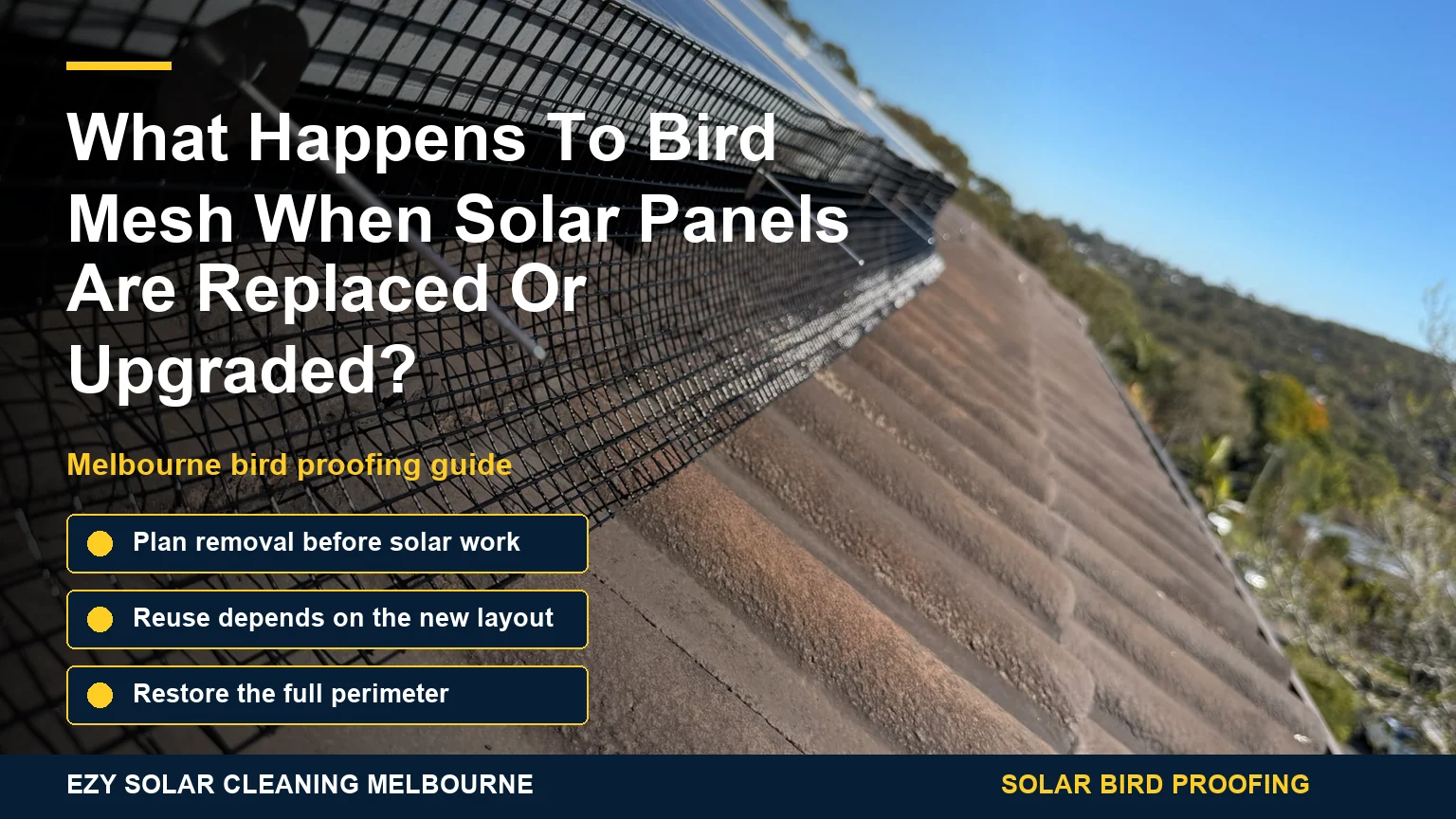
Bird mesh does not prevent solar panels from being replaced or upgraded, but it needs to be included in the work plan. Sections of a properly clipped barrier can be removed to give the solar installer access, then refitted or replaced around the new panel layout.
Whether the original mesh can be reused depends on its condition, how carefully it is removed and whether the replacement system has the same dimensions. The priority is a complete, secure perimeter after the solar work, not reusing old material at any cost.
Tell the solar company before the appointment
When booking a replacement or upgrade, explain that bird mesh is fitted around the array. Send ground-level photos and, if available, the original completion pictures.
Ask the solar provider:
- whether they will remove the mesh
- whether refitting is included
- how much of the array needs to be opened
- whether the new panels change the perimeter dimensions
- whether the bird-proofing installer should attend separately
- how long the roof may remain open between trades
Discovering the mesh only after technicians reach the roof can create delays or leave responsibility unclear.
Different solar jobs affect mesh differently
| Solar work | Likely mesh impact |
|---|---|
| Replace one damaged panel | A local section may be released and refitted |
| Replace the full array | Most or all existing mesh will need removal |
| Add extra panels | The barrier must extend around the new perimeter |
| Rearrange panel rows | Original shaped sections may no longer fit |
| Remove panels for roof work | Mesh must be coordinated with removal and reinstatement |
| Electrical testing only | Mesh may not need removal unless access is obstructed |
The solar technician decides what access is required for the technical work. The bird-proofing result should then be checked by someone who understands perimeter exclusion.
Can the old mesh be reused?
Sometimes. Premium stainless steel mesh may remain serviceable for years, but removal can bend or cut sections. Clips may be lost or unsuitable for a different frame. A new array may sit higher, lower or in a different shape.
Reuse is more realistic when:
- the mesh is still in sound condition
- it was removed carefully
- the new panels follow the same perimeter
- the shaping still matches the roof profile
- suitable clips can secure it correctly
New material is preferable when old mesh is damaged, poorly fitted or no longer matches the system.
Why attachment method matters
EZY Solar Cleaning Melbourne normally uses solar-specific clips rather than drilling, gluing or welding. That approach allows controlled removal without creating permanent holes in the panels or roof.
The existing guide on how mesh is attached without drilling explains why clips are important for both installation and future serviceability.
Improvised screws, adhesive or tangled wire can make solar replacement more difficult and increase the chance of damage during removal.
Do not leave the new array partly open
Pigeons that previously used the roof may notice when the barrier is removed. If the new panels remain unprotected between appointments, birds can inspect or re-enter the space.
Try to coordinate the solar and bird-proofing work closely. Before mesh is refitted, check that no birds, nesting material or work debris are trapped beneath the new array.
Professional solar panel bird proofing should close the complete exposed perimeter of the final layout, including new corners, row gaps and any additional array.
What to inspect after the upgrade
The final barrier should be checked for:
- complete coverage around the changed array
- secure clips suited to the panel frame
- neat corners and joins
- close shaping to the roof profile
- no sharp or loose wire ends
- no opening around conduits or mounting changes
- no overlooked second array
Ask for completion photos if rear edges cannot be viewed safely from the ground.
Who should remove and reinstall the mesh?
Some solar installers are comfortable releasing and replacing simple mesh sections. Others exclude bird-proofing work from their scope. Confirm this before work starts.
For a full system change, involving the bird-proofing provider may be the more reliable option. The two trades can arrange whether removal happens before the solar job and refitting immediately afterwards.
Homeowners should not climb onto the roof and remove mesh themselves. The work is beside solar equipment and may expose old bird contamination.
Keep useful records
Store the original bird-proofing quote, material details and completion photos with the solar system paperwork. These records help future technicians see how the barrier was fitted and which arrays were included.
If the upgraded system has a different layout, request new photos and an updated scope for the reinstated mesh.
FAQ
Must all mesh be removed to replace one panel?
Usually only the affected area needs access, but the solar technician determines the safe repair method.
Can the same clips be reused?
Some may be reusable, but damaged, lost or incompatible clips should be replaced.
Will removing mesh damage the panels?
A properly clipped system is designed to avoid drilling. Careful removal by an appropriate provider reduces unnecessary risk.
What if the new panels are a different size?
The old mesh shaping may not fit. The barrier should be adapted or replaced around the final perimeter.
Can pigeons return while the mesh is off?
Yes, particularly if they previously used the roof. Coordinate prompt reinstatement and inspect before closing the array.
Should the mesh installer or solar company return it?
Confirm responsibility in advance. For complex changes, coordination with the bird-proofing provider is sensible.