
If you’ve invested thousands of dollars into a solar system, the last thing you want is pigeons turning it into their new home.
Unfortunately, birds nesting under solar panels has become a common problem across Melbourne. What starts as a couple of pigeons sitting on the roof can eventually turn into nests, droppings, blocked gutters, noise and expensive cleanup work.
The good news is that preventing birds from nesting under solar panels is much easier than dealing with an established infestation.
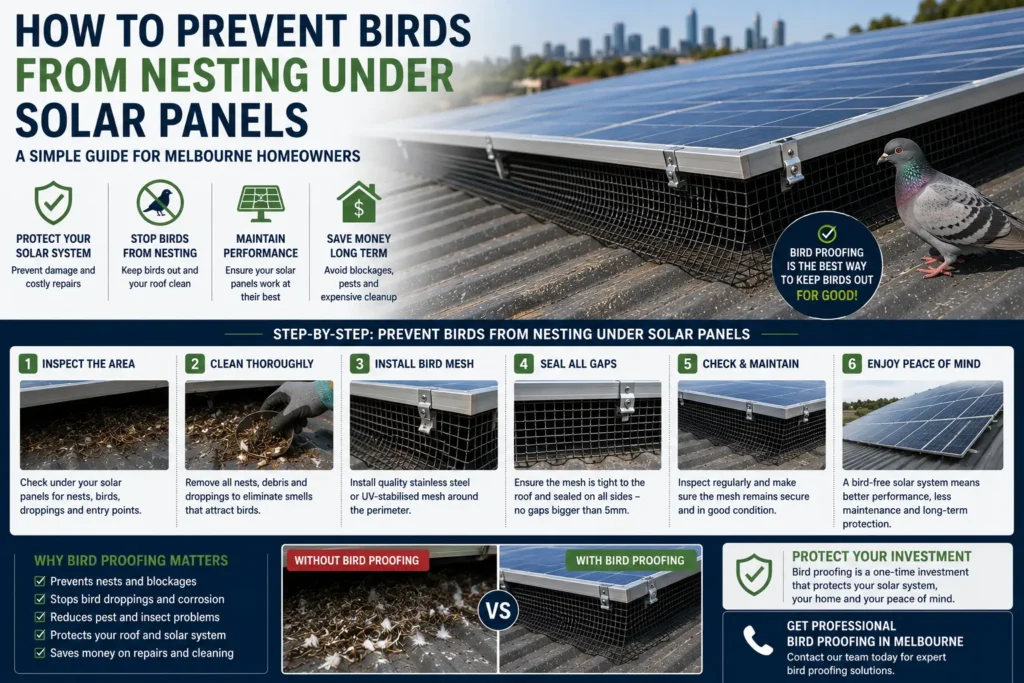
In this guide, we’ll explain why birds choose solar panels, how to spot the warning signs early, and the most effective ways to stop them from moving in.
Why Do Birds Nest Under Solar Panels?
To understand how to prevent birds from nesting under solar panels, it’s important to understand why they’re attracted to them in the first place.
From a pigeon’s perspective, the space underneath a solar array is almost perfect.
It provides:
- Shelter from rain and wind
- Protection from predators
- Shade during hot weather
- A safe place to raise young
Once pigeons discover a suitable nesting location, they often keep returning to it.
That’s why bird problems rarely solve themselves.
The longer birds are allowed to use the space underneath the panels, the more established the colony tends to become.
The Best Way to Prevent Birds From Nesting Under Solar Panels
In our experience, the most effective solution is installing professional solar panel bird proofing.
A properly installed bird proofing system uses mesh around the perimeter of the solar array to physically prevent birds from accessing the space underneath the panels.
This works because it removes the thing pigeons are actually interested in.
The birds aren’t usually attracted to the roof itself.
They’re attracted to the sheltered nesting space underneath the solar panels.
Once access is removed, the roof becomes just another roof.
Why Prevention Is Better Than Waiting
If someone asked for our honest advice after installing a new solar system, we’d recommend considering bird proofing as a preventative measure rather than waiting for a problem to develop.
The reason is simple.
Preventing an infestation is usually easier, cleaner and less expensive than fixing one later.
When bird proofing is installed before pigeons move in:
- There are no nests to remove
- There are no droppings to clean up
- There is no contamination underneath the panels
- There is no solar panel cleaning required due to bird activity
Once birds establish themselves underneath the system, the amount of work involved can increase significantly.
Think of it like insurance.
You invest a little upfront to avoid a much bigger problem later.
Early Warning Signs Birds Are Starting to Nest
One of the best ways to prevent a serious infestation is recognising the signs early.
Birds Spending Time on the Roof
An occasional pigeon isn’t usually a concern.
However, if the same birds are spending long periods sitting on the roof every day, it’s worth paying attention.
Birds Carrying Sticks
This is one of the clearest warning signs.
If you see pigeons flying onto the roof carrying sticks or nesting material, they’re usually building a nest somewhere nearby.
Birds Disappearing Under the Panels
This is probably the most obvious sign of all.
If you see a pigeon land on the roof and then crawl underneath the solar panels, there’s a very good chance they’re either:
- Building a nest
- Using an existing nest
- Living underneath the array
At that point, it’s no longer just a warning sign.
It’s an active nesting problem.
Morning Cooing and Roof Noise
Many homeowners first become aware of pigeons because of the constant morning cooing.
Scratching noises and movement underneath the panels are also common indicators.
More Advanced Signs of a Developing Problem
As an infestation grows, the signs become harder to ignore.
Gutters Filling Up in One Area
If a specific section of your gutter keeps filling with debris despite having no large trees nearby, nesting activity underneath the solar panels may be contributing to the problem.
Plants Growing Out of Gutters
This is often a sign that debris has been accumulating for quite some time.
By this stage, the problem has usually been developing for a while.
Eggshells Around the Property
After chicks hatch, eggshells can sometimes wash off the roof and end up around the home or garden.
While not every homeowner notices this, it can be another clue that birds are nesting overhead.
Why DIY Bird Deterrents Usually Fail
One of the most common mistakes homeowners make is trying to solve a nesting problem with products that don’t actually address the root cause.
Over the years we’ve seen people try:
- Plastic owls
- Rubber snakes
- Reflective discs
- Sonic deterrent devices
- Homemade barriers
- Cheap plastic mesh
- Bird spikes
The problem is that most of these products don’t stop birds from accessing the space underneath the panels.
As long as pigeons can still reach the nesting area, the problem often continues.
Why Bird Spikes Don’t Prevent Nesting Under Solar Panels
Bird spikes are frequently misunderstood.
They’re excellent for preventing birds from landing on:
- Window ledges
- Railings
- Signage
- Other flat surfaces
However, solar panel nesting problems are different.
Pigeons don’t need to land directly on the solar panels.
They can simply land on the roof nearby and walk underneath the array.
That’s why bird spikes often fail as a long-term solution for solar panel nesting problems.
For a detailed comparison, see Solar Panel Bird Mesh vs Spikes: Which Works Better?
Don’t Assume the Birds Will Leave on Their Own
This is one of the biggest misconceptions we encounter.
Many homeowners notice a couple of pigeons and think:
“They’ll move on eventually.”
Sometimes activity decreases temporarily between breeding cycles, which reinforces that belief.
The problem is that pigeons often return to the same nesting location.
In our experience, doing nothing usually allows the problem to grow.
What starts as:
- Two pigeons
- One nest
- A little bit of noise
Can eventually become:
- Multiple nests
- Significant droppings
- Blocked gutters
- Ongoing roof contamination
That’s why acting early is so important.
Why Bird Problems Are So Common in Melbourne
One reason we often recommend preventative bird proofing is because pigeon activity is extremely common across Melbourne.
In many suburbs, pigeons are already well established.
Even if your property doesn’t currently have a problem, there may be active nesting sites nearby.
We’ve even seen situations where a neighbour installs bird proofing, forcing an existing pigeon colony to find a new home.
Often, the next available solar system becomes the target.
What Happens If You Don’t Prevent It?
The consequences vary depending on how severe the infestation becomes.
However, we’ve regularly seen problems such as:
- Heavy droppings on solar panels
- Nesting material underneath arrays
- Blocked gutters
- Roof contamination
- Reduced solar performance
- Large cleanup requirements
For a detailed breakdown, see What Happens If You Don’t Bird-Proof Your Solar Panels?
The Earlier You Act, The Easier It Usually Is
One thing we’ve learned from years of bird proofing jobs is that homeowners rarely regret fixing the problem early.
What they often regret is waiting.
The most common comments we hear are:
- “I thought it wasn’t a big deal.”
- “I thought they would leave.”
- “I wish I had done this sooner.”
The reality is that preventing birds from nesting under solar panels is usually much simpler than dealing with a large established colony later.
Frequently Asked Questions
What is the best way to prevent birds nesting under solar panels?
A professionally installed mesh bird proofing system is generally the most effective long-term solution because it physically prevents birds from accessing the space underneath the panels.
Should I bird proof my solar panels before I have a problem?
In our experience, yes. Prevention is often easier and less expensive than dealing with an established infestation.
How do I know if birds are nesting under my solar panels?
Common signs include birds disappearing underneath the panels, carrying sticks, morning cooing, roof noise, droppings and nesting debris in gutters.
Do bird spikes stop birds nesting under solar panels?
Generally no. Bird spikes may stop birds landing in certain areas, but they don’t prevent access underneath solar panels.
Will pigeons leave on their own?
Sometimes activity temporarily decreases, but pigeons often return to the same nesting location and continue using it.
Can birds reduce solar panel performance?
Yes. Bird droppings can block sunlight from reaching the solar cells, and heavy nesting activity can create additional maintenance issues around the system.
Are pigeons a common problem in Melbourne?
Yes. Pigeons are widespread throughout Melbourne and are one of the most common causes of bird nesting problems under solar panels.
Is bird proofing worth it?
For many homeowners, bird proofing provides long-term protection against nesting, droppings, blocked gutters and the costs associated with established infestations.