
If you’ve discovered pigeons nesting under your solar panels, you’ve probably come across two common solutions:
- Bird mesh
- Bird spikes
At first glance, they might seem like they do the same thing.
After all, both are designed to help prevent bird problems.
However, when it comes to pigeons nesting under solar panels, they work in completely different ways.
In our experience, this is where many homeowners get caught out.
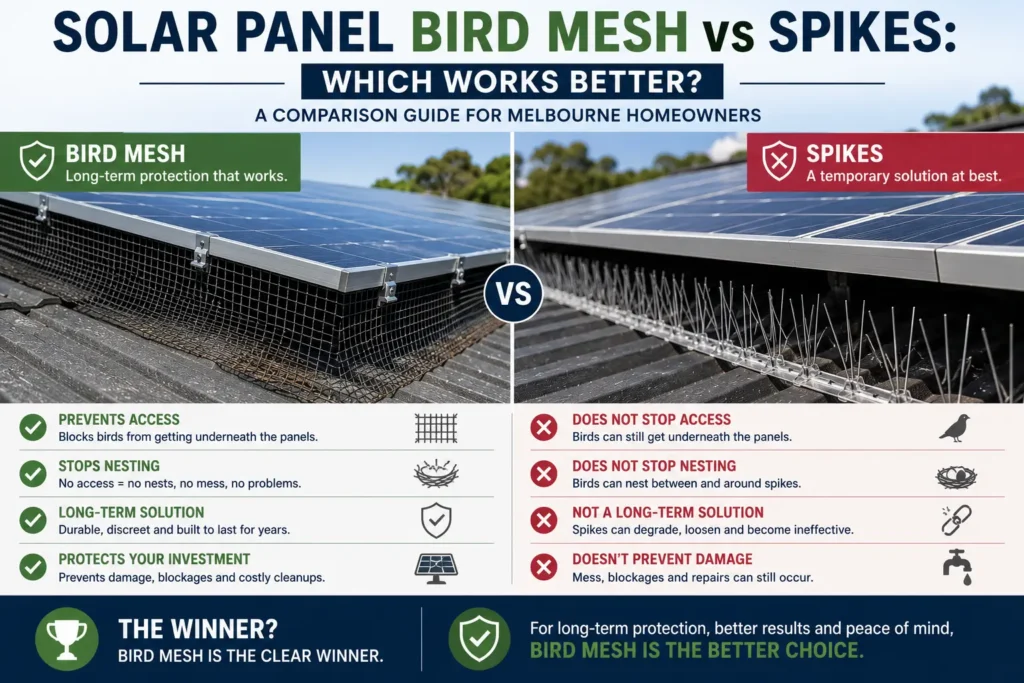
They see bird spikes being used successfully on buildings, window ledges and fences, so they naturally assume the same approach will work on solar panels.
Unfortunately, that’s usually not the case.
In this guide, we’ll compare solar panel bird mesh and bird spikes, explain how each solution works, and help you understand which option is most effective for preventing pigeons from nesting under solar panels.
The Short Answer
If your goal is to stop pigeons nesting underneath solar panels, bird mesh is significantly more effective than bird spikes.
That’s because bird mesh prevents access to the space underneath the solar panels.
Bird spikes do not.
This is an important distinction.
Bird Spikes Stop Birds Landing
Bird spikes are designed to make surfaces uncomfortable for birds to land on.
Bird Mesh Stops Birds Nesting
Bird mesh creates a physical barrier that prevents birds from entering the space underneath the solar panels.
When it comes to solar panel nesting problems, preventing access is what matters most.
How Bird Spikes Work
Bird spikes are a common bird deterrent used on:
- Window ledges
- Signage
- Fences
- Railings
- Building edges
In these situations, they often work very well.
The reason is simple.
The birds want to land on a specific surface.
The spikes make that surface uncomfortable to use.
As a result, the birds move elsewhere.
For many bird-related problems, bird spikes are an effective solution.
The problem is that pigeons nesting under solar panels aren’t trying to land on the solar panels.
They’re trying to access the space underneath them.
Why Bird Spikes Usually Fail on Solar Panels
This is where many homeowners get caught out.
A pigeon doesn’t need to land directly on the solar panel.
It can simply:
- Land on the roof.
- Walk around the spikes.
- Crawl underneath the solar panels.
The nesting area remains accessible.
The problem remains unsolved.
In our experience, we’ve never seen bird spikes successfully solve a pigeon nesting problem under solar panels as a long-term solution.
The birds simply find another way underneath.
How Solar Panel Bird Mesh Works
Bird mesh takes a completely different approach.
Instead of trying to discourage birds from landing, it physically blocks access to the nesting area.
A properly installed solar panel bird proofing system creates a barrier around the perimeter of the solar array.
This prevents pigeons from:
- Entering underneath the panels
- Building nests
- Returning to existing nesting sites
The key difference is that bird mesh addresses the root cause of the problem.
If pigeons can’t access the nesting space, they can’t use it.
Why Most Pigeons Are There in the First Place
One thing we’ve learned after working on many bird proofing jobs across Melbourne is that pigeons aren’t usually attached to the roof itself.
They’re attached to the nesting location.
Homeowners often assume:
“The pigeons like my roof.”
In reality, they usually like the protected space underneath the solar panels.
Once access to that space is removed, the roof becomes just another roof.
That’s why mesh is generally so effective.
Why Homeowners Often Consider Bird Spikes
Most people are familiar with bird spikes.
They’re commonly sold at hardware stores and are often the first solution people think of when they have a pigeon problem.
Some of the reasons homeowners try spikes include:
- They’ve seen spikes used elsewhere
- They assume all bird problems are the same
- They want a DIY solution
- They think spikes will be cheaper
- Someone recommended them
- They don’t know bird mesh exists
These assumptions are understandable.
The problem is that pigeons nesting under solar panels are a very specific type of bird issue that requires a different solution.
A Real Example of Bird Spikes Failing
One job we attended involved a homeowner who had already attempted to solve the problem using bird spikes.
They installed the spikes themselves and assumed the issue had been fixed.
Because they believed the pigeons could no longer access the solar panels, they stopped paying attention to the nesting activity.
Unfortunately, the pigeons continued nesting underneath the array.
The infestation kept growing.
By the time we were called out:
- The spikes had shifted position
- Some had become trapped underneath the panels
- Some had washed into the gutters
- The nesting problem remained unresolved
We ultimately had to remove the failed installation and install bird mesh around the solar array to solve the problem properly.
This isn’t an isolated situation.
It’s one of the reasons we generally don’t recommend spikes as a solution for solar panel nesting issues.
Which Solution Lasts Longer?
When installed correctly using quality materials, bird mesh is designed to provide long-term protection.
Bird spikes can also last for years when installed in appropriate locations.
The issue isn’t durability.
The issue is suitability.
Bird spikes can be durable and still fail to stop pigeons nesting under solar panels because they don’t eliminate access to the nesting area.
Which Option Is More Cost Effective?
Many homeowners initially assume bird spikes will be cheaper.
On paper, they often are.
The problem is that a cheaper solution isn’t always the least expensive solution.
If spikes fail and the pigeons continue nesting underneath the solar panels, homeowners often end up paying for:
- The spikes
- The failed installation
- The cleanup
- The bird mesh installation later
At that point, the cheaper option wasn’t actually cheaper.
In our experience, it’s generally more cost-effective to solve the problem properly the first time.
Can Bird Spikes and Bird Mesh Be Used Together?
In some situations, yes.
Bird spikes can still be useful on:
- Roof ledges
- Window sills
- Fences
- Other landing areas
However, if the goal is preventing access underneath solar panels, bird mesh remains the primary solution.
The spikes may help discourage birds from gathering in certain areas, but they won’t replace the need to block access underneath the solar array.
Our Experience With Bird Mesh vs Spikes
After seeing a wide range of bird proofing jobs, our opinion is fairly simple.
Bird spikes are a useful product.
They’re just not designed for this particular problem.
If you’re trying to stop pigeons landing on a ledge, spikes can work very well.
If you’re trying to stop pigeons nesting underneath solar panels, bird mesh is by far the more effective solution because it removes access to the nesting area altogether.
That’s the fundamental difference.
Frequently Asked Questions
Do bird spikes work on solar panels?
In our experience, bird spikes are generally ineffective for preventing pigeons from nesting underneath solar panels because birds can often access the nesting area from other directions.
Is bird mesh better than spikes?
For solar panel nesting problems, yes. Bird mesh physically blocks access underneath the panels, while spikes are primarily designed to discourage landing.
Why do pigeons get past bird spikes?
Pigeons often land nearby and simply walk around or past the spikes to reach the space underneath the solar panels.
Can bird spikes stop pigeons nesting under solar panels?
We’ve not seen bird spikes consistently solve solar panel nesting problems because they don’t eliminate access to the nesting area.
Is bird mesh visible from the ground?
A professionally installed bird mesh system is typically designed to sit neatly around the perimeter of the solar array and is often difficult to notice from ground level.
Can I install bird spikes myself?
Many homeowners attempt DIY bird spike installations, but they often discover that spikes do not address the underlying nesting problem beneath the panels.
What is the best way to stop pigeons nesting under solar panels?
A professionally installed solar panel bird proofing system using quality mesh remains the most effective long-term solution.
Should I clean my solar panels before installing bird mesh?
If there is heavy contamination from bird droppings, combining bird proofing with solar panel cleaning is often a sensible approach.