
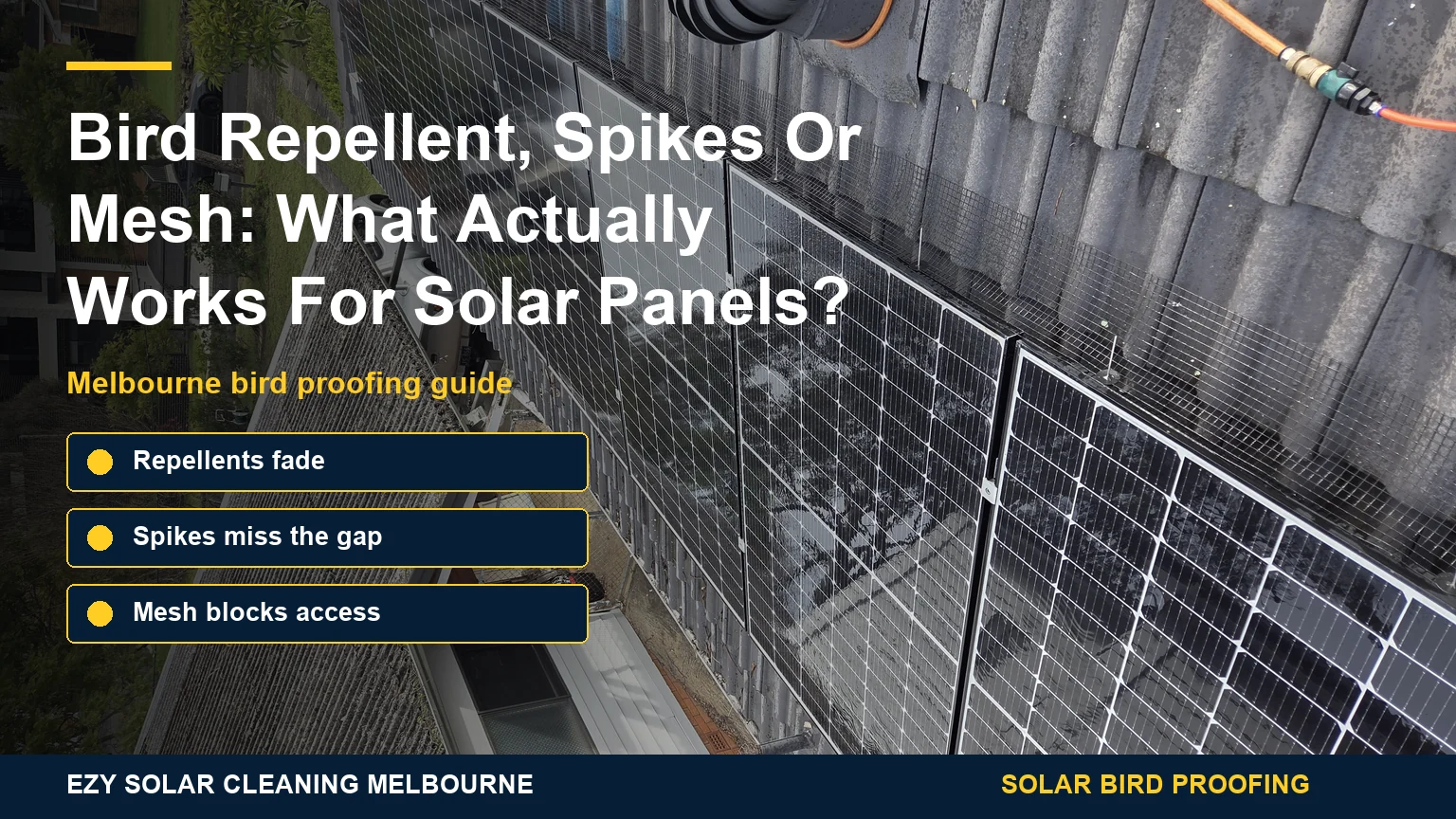
For solar panels, mesh is usually the most reliable option because it physically blocks the gap birds use for shelter. Repellents and spikes may help in some situations, but they do not usually solve the main problem under solar panels: pigeons can still access the protected space beneath the array.
That is why Melbourne solar panel bird proofing is built around access control. The goal is not to annoy the birds. The goal is to remove the nesting space.
Why solar panels are different from ledges
Bird control products often get lumped together, but solar panels create a very specific problem. Pigeons are not just sitting on an exposed ledge. They are trying to get into a sheltered roof cavity created by the panel frame, rails and roof surface.
If a solution does not close that cavity, it may leave the real problem untouched. Birds can land nearby, walk around obstacles, or enter from another side of the panel array.
Bird repellents
Bird repellents can include gels, sprays, visual deterrents, reflective objects, sound devices or moving items. Some may create short-term discomfort, but they rely on changing bird behaviour.
That is a weak strategy when pigeons already know the roof is a safe nesting spot. Once birds have a habit, they may keep returning and testing the area. Repellents can also wear down, move, look messy or become less convincing over time.
Repellents may be more useful for temporary discouragement in some settings, but they are rarely the best standalone solution for birds under solar panels.
Bird spikes
Bird spikes are useful on ledges, rails, signage and window sills where birds are sitting on a narrow exposed surface. Solar panels are different. The problem is the low gap underneath.
Spikes can be placed in the wrong position, shift over time, fall into gutters or simply leave enough space for birds to enter around them. Owner experience includes cases where DIY spikes became extra labour to remove before proper mesh could be installed.
The existing article Solar Panel Bird Mesh vs Spikes: Which Works Better? goes deeper into that exact comparison.
| Option | Where it may help | Weakness around solar panels |
|---|---|---|
| Repellent | Short-term discouragement | Does not close the nesting gap |
| Spikes | Exposed ledges and rails | Birds can often walk around or enter from another edge |
| Netting | Some broader bird control jobs | Can look messy or fail if not suited to solar panels |
| Solar bird mesh | Under-panel access points | Needs proper clips and full perimeter installation |
Solar bird mesh
Mesh works because it changes the roof access. A properly installed system follows the perimeter of the solar array and stops birds from getting under the panels.
The preferred approach for Melbourne solar panels is black PVC-coated stainless steel mesh fitted with solar-specific clips. It should be neat from the ground, firm along the edges and shaped carefully around corners, brackets and awkward sections.
Good mesh should not require drilling into the roof or panels. It should be clipped to the panel frame in a way that blocks access while respecting the solar system.
Why the full perimeter matters
Birds only need one opening. If the front edge is protected but the rear corner is open, the job may fail. Pigeons are persistent around a familiar nesting spot and may test the edges after installation.
This is where workmanship matters. A solar array has corners, rails, gaps between panel rows and sometimes difficult roof shapes. A proper bird proofing job needs to account for those details rather than only covering the easiest visible edge.
Common mistakes are covered in Solar Panel Bird Proofing: Common Mistakes To Avoid, but the simple version is this: the mesh needs to close the full access route, not just look finished from the driveway.
What if the birds are already nesting?
If pigeons are already under the panels, the job may need nest removal and cleaning before or during the mesh installation. Bird proofing stops the return path. Cleaning removes what is already there.
This is why a quote should separate the prevention work from any clean-up work. A roof with light early activity is not the same as a roof with months of droppings, dead birds, feathers and packed nesting material.
How to choose without overthinking it
For a Melbourne homeowner, the decision can be simplified:
- If birds are sitting on a ledge away from solar panels, spikes may be relevant.
- If birds are testing the gap under panels, mesh is usually the proper answer.
- If droppings and nests are already present, cleaning may need to be included.
- If the quote does not mention full perimeter coverage, clips and gaps, ask more questions.
The practical takeaway
Repellents and spikes try to make birds choose somewhere else. Mesh removes the sheltered space they are choosing. For solar panels, that difference matters. If the roof has pigeons under the panels, the long-term fix is usually a neat, full-perimeter mesh installation.
FAQ
Do bird repellents work for solar panels?
They may discourage birds temporarily, but they do not usually block the sheltered gap under solar panels.
Are spikes good for solar panels?
Spikes can work on ledges, but they usually do not seal the low gap beneath solar panels.
Why is mesh better for pigeons under panels?
Mesh physically blocks the access point. If pigeons cannot get underneath, they cannot keep using the panels as a nesting shelter.
Can I use netting instead of mesh?
General netting may not suit solar panels and can look messy or fail if fitted poorly. Solar-specific mesh is usually the better option.
Will mesh damage my solar panels?
Professional installation should use solar-specific clips and avoid drilling, gluing or welding. Warranty details can depend on the manufacturer and installation method.
What if birds still sit near the panels?
That can happen for a while. The important question is whether they can still get underneath the panels.