
If you’ve already got solar panels on your roof and you’ve started noticing pigeons hanging around, you might be wondering:
Can bird proofing be added after the solar panels have already been installed?
The simple answer is yes.
In fact, most bird proofing jobs are completed on existing solar systems rather than brand-new installations.
Many homeowners assume they missed their opportunity because the solar panels have already been installed. Others worry that bird proofing will require removing the panels, drilling into the system or voiding the warranty.
Fortunately, that’s usually not the case.
In this guide, we’ll explain how bird proofing is added to existing solar panels, what the process involves, and why it’s often easier than homeowners expect.
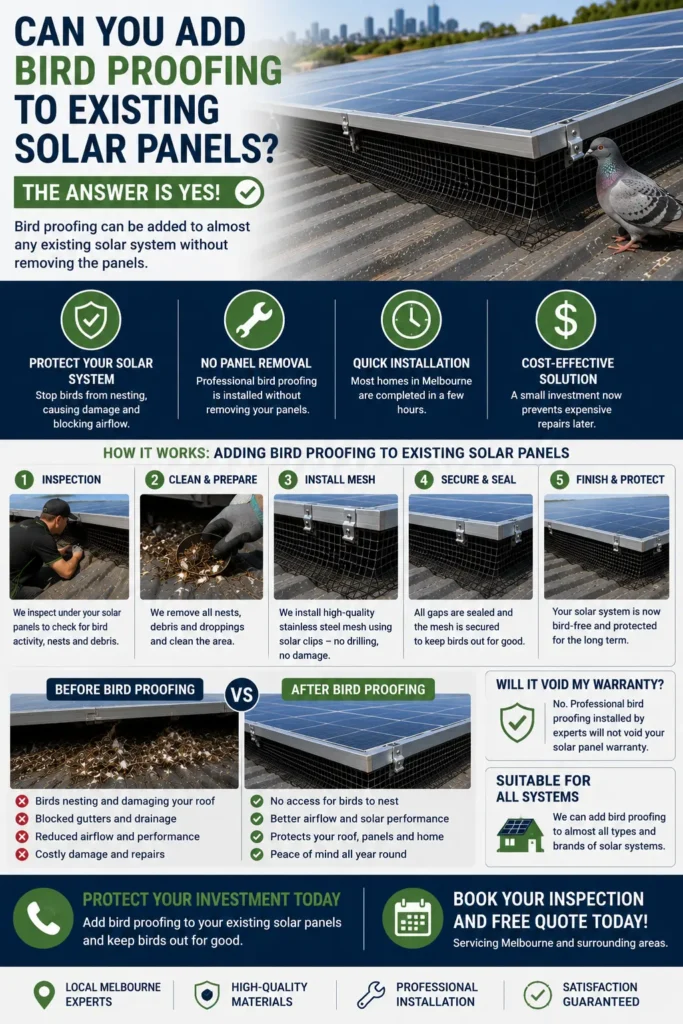
Yes, Bird Proofing Can Be Added to Existing Solar Panels
One of the biggest misconceptions we encounter is that bird proofing must be installed at the same time as the solar system.
While bird proofing can certainly be installed on a new system as a preventative measure, it’s far more common for homeowners to add it later.
From our experience, roughly:
- 80% of bird proofing jobs involve existing solar systems
- 20% are preventative installations on newer systems
That means most homeowners who contact us are in exactly the same situation.
Their solar panels have already been installed and they’re only now looking to solve a bird problem or prevent one from developing.
Why Most People Wait
In an ideal world, bird proofing would be installed before pigeons ever discover the space underneath the panels.
However, that’s not how it usually happens.
Most homeowners don’t think about bird proofing until they start noticing:
- Pigeons on the roof
- Morning cooing
- Birds disappearing underneath the panels
- Droppings around the property
- Nesting activity
By the time they start researching solutions, the solar system may have been installed for months or even years.
The good news is that this doesn’t prevent bird proofing from being installed.
Do Solar Panels Need to Be Removed?
This is probably the most common question homeowners ask.
The answer is generally no.
A properly installed bird proofing system does not require the solar panels to be removed from the roof.
Instead, the mesh is installed around the perimeter of the solar array while the panels remain exactly where they are.
The process is typically much simpler than people expect.
The bird proofing mesh is attached to the frame of the solar panels using specialised solar clips designed for this purpose.
There is no need to:
- Remove the panels
- Disconnect the system
- Drill into the solar panels
- Make major modifications to the installation
For most residential systems, the existing solar array remains completely intact throughout the process.
How Bird Proofing Is Installed on Existing Solar Panels
The installation process usually follows a straightforward sequence.
Step 1: Assess the Solar System
The first step is understanding the layout of the solar array and determining how much perimeter protection is required.
This helps identify the materials and installation method needed.
Step 2: Remove Existing Nests and Debris
If birds are already nesting underneath the panels, the area needs to be cleaned before the bird proofing can be installed.
Depending on the infestation, this may involve removing:
- Nesting material
- Feathers
- Bird droppings
- General debris
Many homeowners are surprised by how much mess can accumulate underneath a solar array.
Step 3: Install the Mesh
Once the area is clean, the bird proofing mesh is installed around the perimeter of the panels.
The mesh creates a physical barrier that prevents birds from accessing the space underneath the system.
Step 4: Optional Solar Panel Cleaning
If the panels have been heavily contaminated by bird droppings, many homeowners choose to combine bird proofing with solar panel cleaning.
This helps restore the appearance and cleanliness of the system after the nesting problem has been addressed.
Can Bird Proofing Be Added to Older Solar Systems?
Yes.
We’ve installed bird proofing on solar systems that have been on roofs for more than 10 years.
The age of the system is usually not the deciding factor.
What matters most is:
- Whether birds can access underneath the panels
- The layout of the solar array
- The condition of the installation
If there is a gap underneath the panels that birds can use, bird proofing can usually be installed to close that access.
Is It Too Late If Birds Are Already Nesting?
Not at all.
In fact, most bird proofing jobs involve active nesting sites.
Homeowners often assume they should wait until the pigeons leave before installing bird proofing.
This usually isn’t necessary.
The nests and debris can be removed, and the perimeter can then be sealed to prevent the birds from returning underneath the panels.
The sooner the problem is addressed, the easier it typically is to manage.
As we’ve discussed in What Happens If You Don’t Bird-Proof Your Solar Panels?, waiting often allows the infestation to grow and creates more cleanup work later.
Will Bird Proofing Damage My Solar Panels?
This is one of the biggest concerns homeowners have.
It’s also one of the most common misconceptions.
A properly installed bird proofing system should not damage the solar panels.
Professional bird proofing uses specialised clips designed to attach to the frame of the solar panels without drilling or modifying the system.
Unfortunately, we’ve seen situations where DIY installations or poor-quality workmanship have caused problems because the wrong methods were used.
That’s why it’s important to use appropriate materials and installation techniques.
Will Bird Proofing Void My Warranty?
This is another question we hear regularly.
Many homeowners worry that adding bird proofing to an existing solar system will void the manufacturer’s warranty.
When installed correctly using appropriate solar clips and without drilling into the panels, bird proofing should not require modifications that damage the solar system.
This is one reason why choosing an experienced installer is so important.
Why Adding Bird Proofing Later Is Still Worth It
While preventative bird proofing is often the ideal scenario, it’s never too late to protect a solar system from ongoing nesting activity.
Many homeowners only discover they have a problem after:
- Hearing constant cooing
- Finding droppings around the property
- Discovering blocked gutters
- Seeing birds disappear underneath the panels
Adding bird proofing at this stage can still prevent years of future nesting, contamination and maintenance issues.
The important thing is taking action before the infestation becomes significantly worse.
What to Expect After Installation
Once bird proofing has been installed, the space underneath the panels is no longer accessible.
In some cases, pigeons may continue returning to the roof for a short period because they’re used to nesting there.
This is particularly common when the birds have occupied the location for a long time.
Over time, however, they typically move on because they can no longer access their nesting area.
The result is:
- No new nests
- Less noise
- Cleaner gutters
- Cleaner panels
- A much lower chance of future bird-related problems
Frequently Asked Questions
Can bird proofing be installed after solar panels are already on the roof?
Yes. Most bird proofing jobs are completed on existing solar systems rather than brand-new installations.
Do solar panels need to be removed to install bird proofing?
No. In most cases, the panels remain in place while the bird proofing mesh is installed around the perimeter.
Can bird proofing be added to older solar systems?
Yes. We’ve installed bird proofing on systems that have been on roofs for more than 10 years.
Is it too late if pigeons are already nesting under the panels?
No. Existing nests and debris can be removed before the bird proofing system is installed.
Will bird proofing damage my solar panels?
A properly installed bird proofing system should use specialised solar clips and should not require drilling into the panels.
Can bird proofing void my warranty?
When installed correctly using appropriate methods, bird proofing should not require modifications that damage the solar system.
How long does it take to add bird proofing to existing solar panels?
Most residential installations can typically be completed within a few hours, depending on the size of the system and whether cleanup is required.
Should I combine bird proofing with solar panel cleaning?
If bird droppings have accumulated on the panels, combining bird proofing with solar panel cleaning is often a sensible option.