
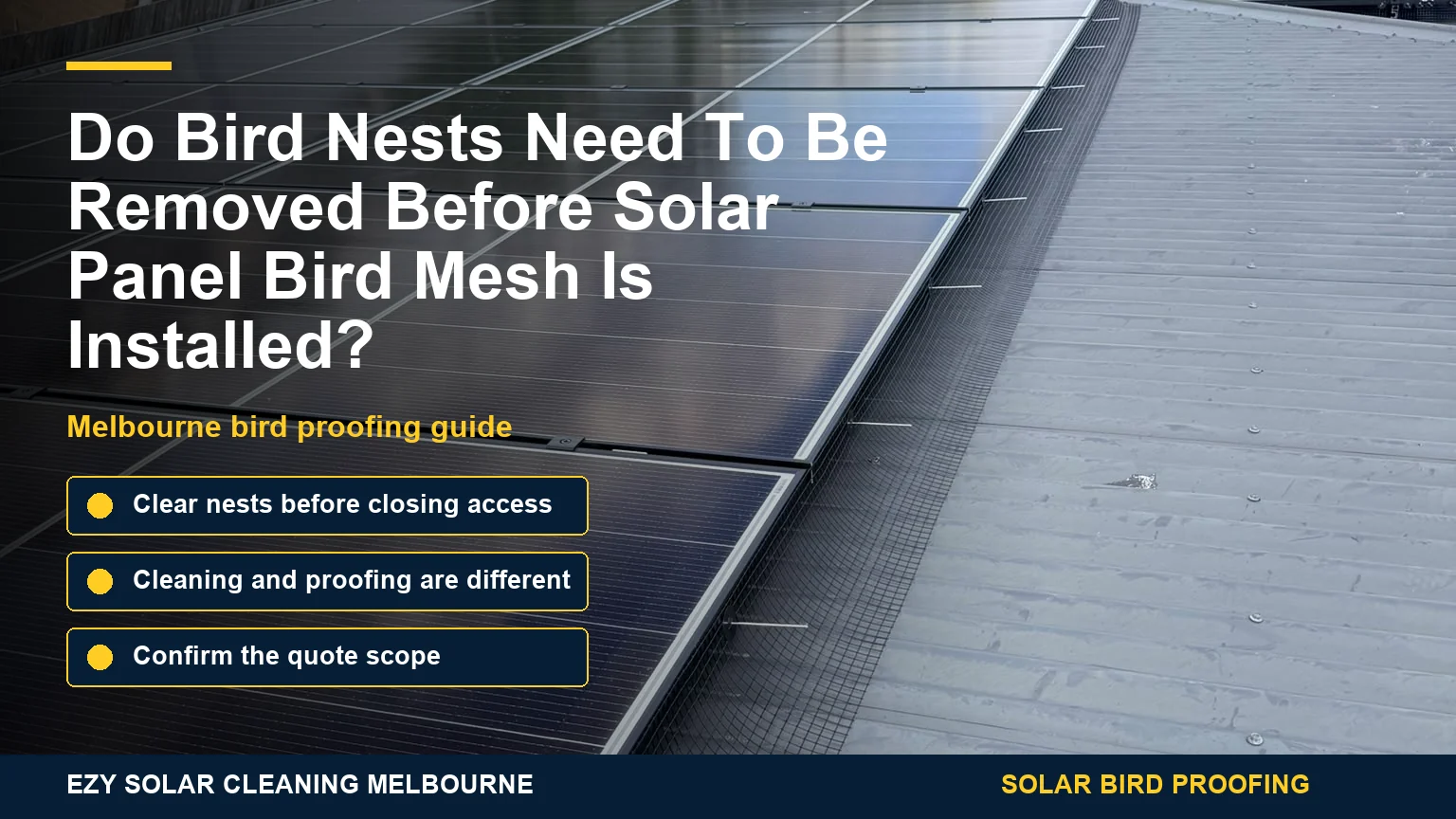
Existing bird nests and loose nesting debris should be addressed before mesh closes the perimeter around solar panels. The installer needs to avoid sealing active birds, chicks, eggs or a large amount of loose material beneath the array.
The amount of work varies. A roof targeted only recently may have a few sticks near one edge. A long-running pigeon problem can involve several nests, feathers, droppings, dead birds and debris spread beneath the panels and into the gutter.
Why the area needs checking first
Bird mesh prevents future access; it does not make existing material disappear. Closing the perimeter without checking underneath can leave contamination in place and may create an animal-welfare problem if birds are still present.
A proper assessment should consider:
- whether pigeons are actively entering
- whether eggs or chicks may be present
- how much nesting material is visible
- whether loose debris can be removed safely
- whether droppings affect the panels or roof
- whether gutter sections are blocked
- whether pest treatment advice may be required in a severe case
Homeowners should not reach beneath panels or climb onto the roof to investigate. Old nests and droppings can be unpleasant, and roof access around solar equipment requires appropriate precautions.
Nest removal, clean-out and panel cleaning are not identical
| Task | Main purpose |
|---|---|
| Nest removal | Remove built nesting material from beneath or around panels |
| Under-panel clean-out | Clear loose sticks, feathers and accessible debris |
| Solar panel cleaning | Remove droppings, dirt and grime from the glass surface |
| Gutter cleaning | Restore affected gutter sections where included |
| Bird mesh installation | Stop birds entering beneath the panels again |
A quote may include some or all of these tasks. Ask for the scope in writing rather than assuming the word “bird proofing” includes a complete roof wash or gutter service.
The article on whether panels need cleaning before bird proofing explains when glass cleaning may be useful alongside the exclusion work.
What if the nest appears active?
Active nesting needs to be handled carefully. Timing, species and the condition found on the roof can affect what is appropriate. The installer should not knowingly trap birds beneath the panels.
From the ground, repeated trips carrying sticks or food, constant movement at one edge and frequent noise may suggest active use. Share those observations when requesting a quote. Do not disturb the nest yourself in the hope of making the birds leave permanently; if the opening remains, pigeons can rebuild.
Why removing the nest alone is not a long-term solution
Pigeons are location-oriented. Once the panel gap has worked as shelter, they may return after material is removed. Cleaning the area can improve the immediate condition but does not change access.
Proper solar panel bird proofing uses a physical mesh barrier around the included perimeter. Premium stainless steel mesh with a UV-stabilised protective coating is fitted with solar-specific clips, without drilling, gluing or welding.
This addresses the root cause: the usable gap beneath the panels.
What homeowners often underestimate
Owner experience shows that the volume beneath an array can be much greater than expected from the driveway. Panels hide the central roof area, while loose material moves downhill into gutters. A few visible sticks can be the edge of a larger build-up.
Common surprises include:
- several nesting sites beneath one array
- droppings across roof surfaces hidden by panels
- blocked gutters below the active edge
- feathers and eggshells around the property
- dead birds or old abandoned material
- birds using more than one panel group
This does not mean every job is severe. It means the quote should be based on evidence rather than assuming a clean roof.
A sensible order of work
For an established problem, the general sequence is:
1. assess the complete solar layout and bird entry points 2. confirm whether active birds or nests are present 3. remove nests and loose debris included in the scope 4. clean affected surfaces where agreed 5. fit mesh around the complete included perimeter 6. inspect corners, row changes and separate arrays 7. provide completion photos
The exact process depends on access and roof condition. It should be explained before work starts.
Questions to ask about the quote
Ask whether nest removal, debris clean-out, panel washing and gutter work are included or separate. Also ask how the installer handles an active nest, whether every array is covered and whether photographs are provided.
The article on professional Melbourne bird proofing provides a broader checklist for workmanship and service scope.
FAQ
Can mesh be installed over an old empty nest?
Loose nesting material should generally be removed where accessible before the perimeter is closed.
Does nest removal include washing the panels?
Not automatically. Confirm whether panel cleaning is included as a separate line in the quote.
Will pigeons rebuild after a nest is removed?
They may if they can still get underneath. Removing access is the long-term prevention step.
Can I pull sticks out from the gutter myself?
Avoid roof access and do not assume visible sticks are the whole nest. Arrange an appropriate assessment.
What if there are eggs or chicks?
Tell the provider about observed activity. Active nesting should be handled carefully rather than sealed inside.
Do all bird-proofing jobs require a major clean-out?
No. Preventative jobs may have little or no nesting material. Established infestations can require considerably more work.