
One of the most common questions homeowners ask is:
“When should I install bird proofing on my solar panels?”
The simple answer is:
The earlier, the better.
However, not every homeowner is at the same stage.
Some are installing a brand-new solar system and want to prevent future problems.
Others have already noticed pigeons sitting on the roof.
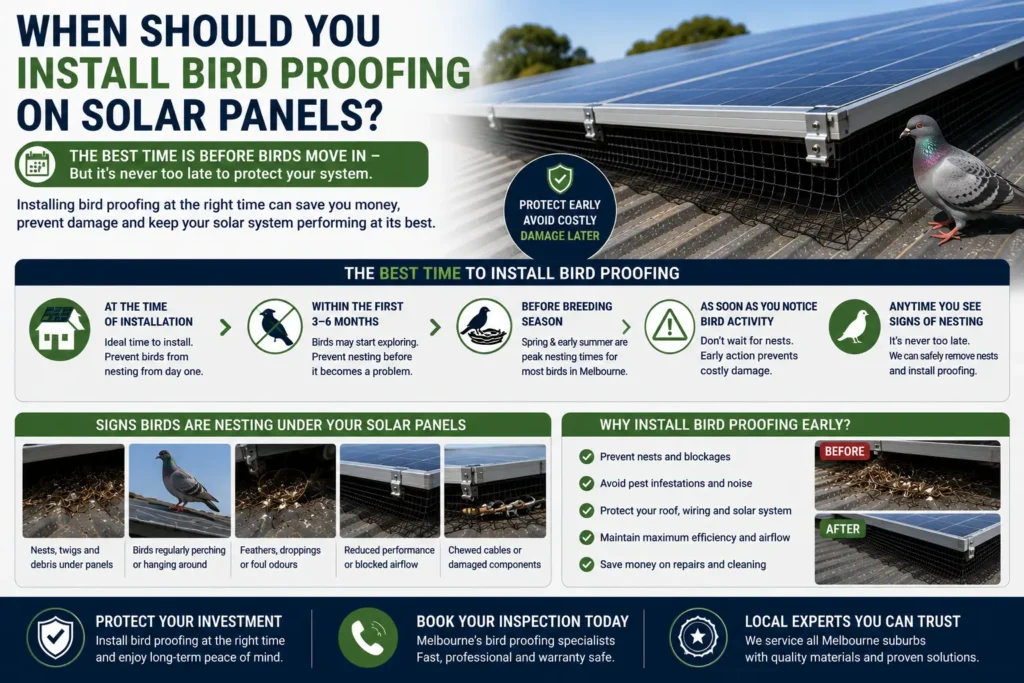
Some are dealing with active nesting.
And unfortunately, some only start looking into bird proofing after a major infestation has developed.
In this guide, we’ll explain the best time to install bird proofing, the warning signs to look for, and why acting early can save a lot of money and frustration later.
The Best Time to Install Bird Proofing
If we had to rank the best times to install bird proofing, the order would be quite simple.
1. At the Same Time as the Solar Panels Are Installed
This is by far the best time to install bird proofing.
Why?
Because there are no birds yet.
There are:
- No nests
- No droppings
- No contamination
- No cleanup requirements
- No blocked gutters
- No solar panel cleaning needed because of bird activity
The installation is purely preventative.
In our experience, this is the smartest long-term approach for many Melbourne homeowners.
If we were installing a solar system on our own home, we’d strongly consider bird proofing from day one.
Not because bird problems are guaranteed.
But because pigeon activity is extremely common across Melbourne and prevention is almost always easier than dealing with an established infestation later.
Why Prevention Often Makes Sense
Many homeowners view bird proofing as something you only install once there’s a problem.
The reality is that preventative bird proofing is often similar to insurance.
You invest a little upfront to reduce the risk of a much bigger problem in the future.
As discussed in How to Prevent Birds From Nesting Under Solar Panels, preventing access underneath the solar panels is generally far easier than removing established nests later.
The Second Best Time: At the First Sign of Bird Activity
If your solar panels are already installed and you start noticing pigeons around the roof, this is usually the next best time to act.
Some of the earliest warning signs include:
- Pigeons regularly sitting on the roof
- Morning cooing
- Birds carrying sticks
- Birds repeatedly returning to the same area
- Birds investigating the space underneath the panels
At this stage, the problem may still be relatively small.
Often there are only a few birds and little or no nesting material underneath the panels.
Installing bird proofing now can prevent the situation from becoming significantly worse.
The Most Important Warning Sign
If you see pigeons disappear underneath your solar panels, that’s usually a very strong indication that they are either:
- Building a nest
- Using an existing nest
- Living underneath the solar array
At that point, you’re no longer dealing with a potential problem.
You’re dealing with an active bird nesting issue.
The sooner it’s addressed, the easier it usually is to manage.
The Third Best Time: After Nesting Has Started
Many homeowners only start researching bird proofing after they realise pigeons are already nesting underneath the panels.
The good news is that bird proofing can still be installed very effectively at this stage.
However, additional work is usually required.
This may include:
- Nest removal
- Debris removal
- Cleaning underneath the panels
- Optional solar panel cleaning
The birds have already established themselves, which means there is generally more work involved than there would have been during the prevention stage.
As explained in Can You Add Bird Proofing to Existing Solar Panels?, most bird proofing installations are actually completed on existing solar systems rather than new installations.
So if your panels already have birds underneath them, you’re certainly not alone.
The Worst Time to Install Bird Proofing
If we’re being completely honest, the worst time to install bird proofing is after a major infestation has developed.
Unfortunately, this is often the result of waiting too long.
Many homeowners tell themselves:
- “It’s only a couple of pigeons.”
- “They’ll leave eventually.”
- “I’ll deal with it next year.”
- “It’s not a big problem.”
We’ve heard all of these before.
The trouble is that pigeon problems rarely stay the same.
They usually grow.
What Happens When You Wait Too Long?
A small pigeon problem often starts with:
- One nest
- A couple of birds
- Some noise
Over time, that can become:
- Multiple nests
- Significant droppings
- Heavy contamination
- Blocked gutters
- Large cleanup jobs
We’ve seen homeowners shocked by the amount of nesting material and waste that can accumulate underneath solar panels in a relatively short period of time.
For a more detailed look at what can happen, see What Happens If You Don’t Bird-Proof Your Solar Panels?
Is There a Best Time of Year to Install Bird Proofing?
This is another common question.
Many homeowners assume there must be a specific bird nesting season when they need to act.
In our experience, pigeon activity in Melbourne doesn’t really work that way.
Pigeons don’t all follow one large seasonal cycle.
Instead, they tend to operate in smaller breeding cycles throughout the year.
What we often see is:
- A period of heavy activity
- A quieter period
- Another period of activity
This pattern can continue throughout the year.
Summer vs Winter
Generally speaking:
- Summer tends to have more pigeon activity
- Winter tends to be a little quieter
However, bird nesting problems can occur at any time of year.
For that reason, we don’t recommend waiting for a particular season.
If birds are already showing signs of nesting, it’s usually better to deal with the problem sooner rather than later.
Why Melbourne Homeowners Should Stay Alert
One thing we’ve noticed over the years is that pigeon problems can sometimes appear surprisingly quickly.
Sometimes the issue starts with just a couple of birds.
Other times, pigeons move into a new property after being displaced from a nearby roof.
For example, if a neighbouring home installs solar panel bird proofing and a large pigeon colony suddenly loses access to its nesting area, those birds often look for another nearby location.
That can sometimes mean the next accessible solar system becomes the new target.
This is one reason why homeowners shouldn’t assume they’re safe simply because they don’t currently have a problem.
So When Should You Install Bird Proofing?
If we had to give one simple answer, it would be this:
Install bird proofing as early as possible.
The ideal time is when the solar panels are first installed.
The next best time is the moment you start seeing signs of pigeon activity.
The worst option is waiting until a large infestation develops.
Bird proofing is still effective at every stage.
The difference is how much cleanup, labour and expense may be involved by the time you decide to act.
Frequently Asked Questions
When is the best time to install bird proofing on solar panels?
The ideal time is during the initial solar panel installation before birds have a chance to establish themselves underneath the array.
Should I install bird proofing before I have a bird problem?
In our experience, yes. Preventative bird proofing is often simpler, cleaner and less expensive than dealing with an established infestation later.
What are the first signs birds are nesting under solar panels?
Common signs include pigeons spending time on the roof, carrying sticks, morning cooing and birds disappearing underneath the solar panels.
Is it too late if pigeons are already nesting?
No. Bird proofing can still be installed very effectively after nesting has begun. However, nest removal and cleanup may be required first.
Do pigeons nest all year round in Melbourne?
Pigeon activity tends to fluctuate throughout the year. While summer is often busier, nesting activity can occur during any season.
Should I wait until winter to install bird proofing?
Not necessarily. If birds are already showing signs of nesting, waiting generally provides little benefit and can allow the problem to become worse.
Does bird proofing work on older solar systems?
Yes. Bird proofing can be added to existing solar systems, including systems that have been installed for many years.
Why do pigeon problems get worse over time?
Pigeons often return to successful nesting locations and can attract additional birds. Over time, this can lead to larger colonies, more nests and more contamination.